Quick Answer
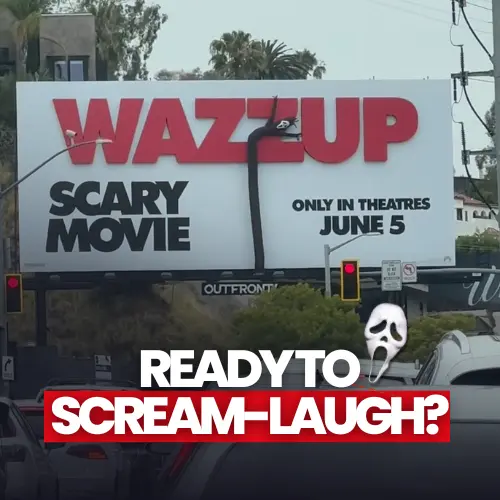
Paramount promotes Scary Movie 6 with a Sunset Boulevard billboard that prioritizes humor over fear, staying true to the franchise’s parody-driven identity.
Cultural Context: Horror Marketing Usually Relies on Tension and Fear
Most horror campaigns follow a familiar playbook.
Dark visuals, ominous taglines, jump-scare aesthetics, and psychological discomfort dominate category conventions.
This repetition has created highly recognizable visual codes:
- Distorted faces
- Red and black palettes
- Threatening copy
- Suspense-heavy imagery
The challenge for parody franchises like Scary Movie is different.
The brand exists to mock these conventions, not reproduce them.
That means the marketing must communicate comedy immediately while still signaling the horror genre.
Insight: Audiences Want Familiarity, But Also Relief
The campaign is grounded in a useful entertainment truth:
Parody works because audiences already understand the thing being parodied.
Scary Movie succeeds by exaggerating the clichés of horror films viewers already know.
Its audience expectation is fundamentally different from standard horror:
People are not looking to feel scared.
They are looking to recognize—and laugh at—the things that usually scare them.
This changes the role of advertising entirely.
The campaign does not need suspense. It needs recognition and tonal accuracy.

Media Strategy: Sunset Boulevard as Entertainment Territory
Placing the billboard on Sunset Boulevard in Los Angeles carries strategic weight.
The location functions as both:
- A high-visibility OOH environment
- A symbolic center of entertainment culture
For film campaigns, Sunset Boulevard offers:
- Industry visibility
- Tourist traffic
- Social amplification potential
The placement reinforces the campaign’s cultural positioning as entertainment rather than niche genre marketing.
The billboard behaves like a public teaser for audiences already fluent in Hollywood tropes.
Creative Execution: Humor as Genre Signaling
Rather than imitate conventional horror campaigns, the creative reportedly leans directly into comedy.
This matters because Scary Movie is fundamentally a tonal balancing act.
Too much horror and the parody disappears.
Too much randomness and the franchise loses genre connection.
Humor becomes the clearest shortcut to audience understanding.
The billboard signals immediately:
This is horror you are supposed to laugh at.
That clarity reduces friction and strengthens recall.

Strategic Impact: Staying Faithful to Franchise Equity
Long-running franchises often struggle between reinvention and consistency.
For Scary Movie 6, maintaining the parody DNA is essential.
The billboard reinforces key franchise associations:
- Self-awareness
- Pop culture satire
- Genre humor
- Accessible comedy
Rather than chase modern elevated-horror aesthetics, the campaign leans into what made the brand culturally distinctive in the first place.
That consistency helps reconnect older audiences while introducing the tone to newer ones.
Execution Insight: Comedy Requires Faster Communication Than Horror
Horror advertising can build mystery slowly. Comedy has less time.
OOH environments demand immediate understanding.
A humorous visual works particularly well because audiences process it instantly, especially in traffic-heavy areas like Sunset Boulevard.
The creative likely prioritizes:
- Quick readability
- Immediate tonal recognition
- High memorability
In comedy marketing, speed often matters more than complexity.

Final Reflection: When Horror Advertising Stops Taking Itself Seriously
The Scary Movie 6 billboard demonstrates the value of tonal discipline.
Rather than borrowing the aesthetics of contemporary horror, the campaign stays loyal to the franchise’s central idea: fear is funniest when it becomes ridiculous.
In a genre crowded with seriousness and dread, humor itself becomes differentiation.
And sometimes the smartest way to stand out in horror marketing is not to terrify people—but to remind them why they loved laughing at horror in the first place.
Summary
Paramount Pictures launched an OOH billboard for Scary Movie 6 on Sunset Boulevard in Los Angeles, using humor rather than suspense to reflect the franchise’s long-standing parody roots. Instead of mimicking traditional horror marketing, the creative leans into absurdity, reinforcing the idea that audiences are meant to laugh at fear rather than fear itself.
Sources
FAQs
What is the campaign about?
It promotes Scary Movie 6 through a humorous billboard on Sunset Boulevard.
Where is the billboard located?
The campaign appears on Sunset Boulevard in Los Angeles.
What makes it innovative?
It rejects traditional horror marketing in favor of parody-driven humor.
What was the strategic insight?
Audiences engage with parody horror through recognition and comedy rather than fear.
FAQs about this campaign
What is the campaign about?
It promotes Scary Movie 6 through a humorous billboard on Sunset Boulevard.
Where is the billboard located?
The campaign appears on Sunset Boulevard in Los Angeles.
What makes it innovative?
It rejects traditional horror marketing in favor of parody-driven humor.
What was the strategic insight?
Audiences engage with parody horror through recognition and comedy rather than fear.
Bring your idea to breakfast-time OOH
Explore formats that meet audiences in morning routines and commuter corridors.

Comments
Be the first to comment.