Quick Answer
Focus Features promotes Obsession with interactive OOH billboards that begin as romantic messages and evolve into unsettling psychological encounters through text interaction.
Cultural Context: Horror Marketing Is Becoming Participatory
Traditional horror advertising often relies on suspenseful trailers, jump scares, or ominous imagery.
But audience behavior has changed. Horror fans increasingly seek experiences that blur fiction and reality—campaigns that feel immersive, personal, and psychologically engaging.
At the same time, texting has become one of the most emotionally loaded forms of communication.
Few things trigger anticipation or anxiety faster than:
- Waiting for a reply
- Receiving unexpected messages
- Experiencing emotional ambiguity through text
The campaign recognizes that modern obsession often lives inside digital communication.
Insight: Romantic Behavior and Psychological Fear Share the Same Language
The campaign is built on a sharp emotional truth:
The line between affection and discomfort can be surprisingly thin.
A message like:
“I love you so so so much”
can feel sweet in one context and unsettling in another.
By beginning with familiar romantic cues and slowly escalating tension, the campaign mirrors real emotional experiences around attachment, expectation, and control.
That psychological realism makes the horror more effective.
Media Strategy: OOH as Entry Point, Mobile as Experience
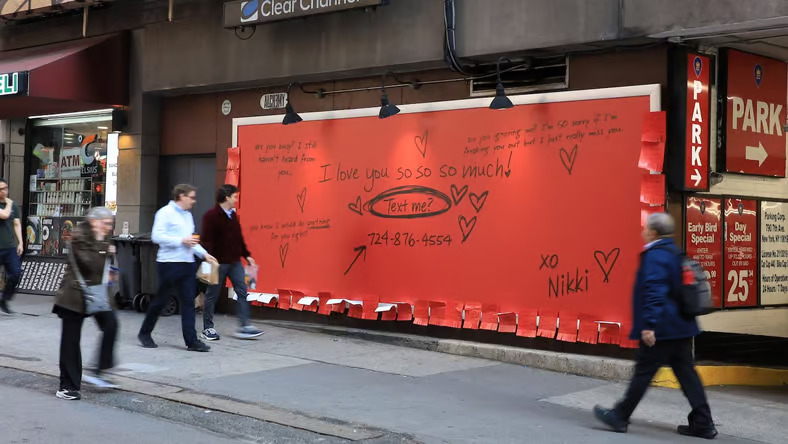
The campaign uses high-footfall billboards in Los Angeles and New York as the first layer of interaction.
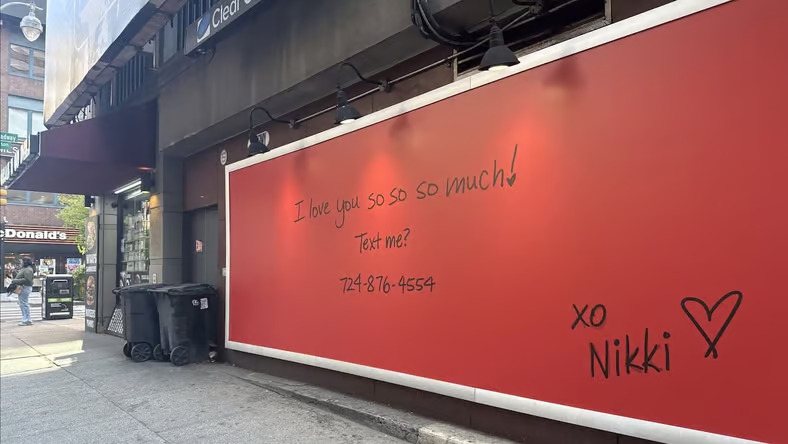
The executions begin simply:
“Text me?”
signed “xo Nikki”.
This creates intrigue through minimalism.
The second layer is mobile participation. Once users text the number, the campaign evolves into a one-sided relationship with Nikki, whose messages become progressively unsettling.
This transforms OOH from awareness media into behavioral media.
Instead of simply seeing the campaign, audiences actively enter it.
Creative Execution: The Slow Shift From Romance to Fear
One of the campaign’s strongest creative decisions is pacing.
The emotional shift happens gradually.
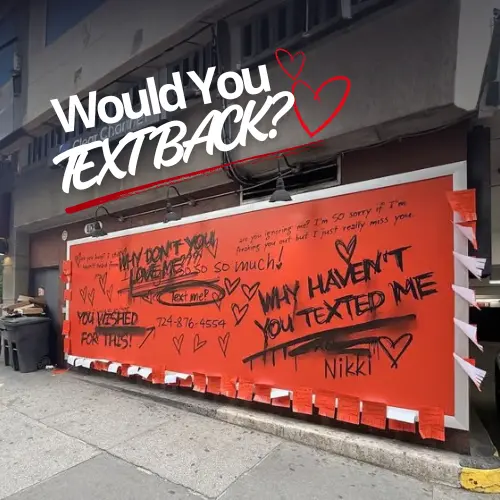
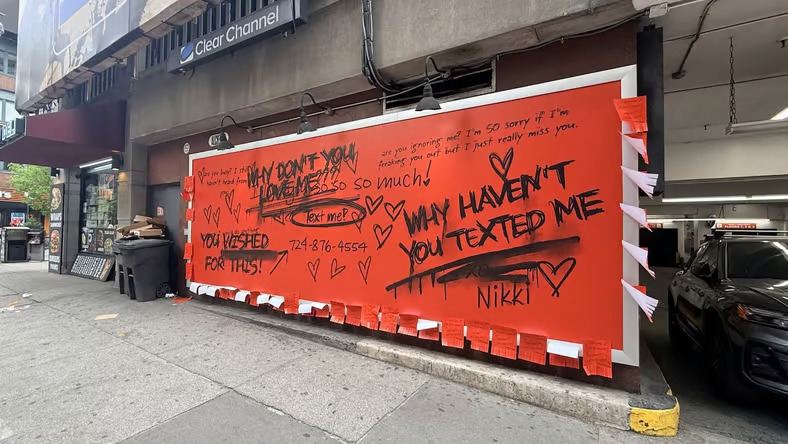
Early billboards lean into handwritten love-note familiarity. Later executions become more chaotic:
- Scribbled text
- Crossed-out words
- Emotional escalation
-
Repeated questions like:
“Why haven’t you texted me?”
This progression mirrors obsessive behavior itself.
The tension does not arrive immediately—it accumulates.
That slow burn aligns naturally with psychological horror storytelling.
Experiential Design: Horror That Follows You Home
Unlike traditional OOH, the campaign does not end once audiences leave the billboard.
By moving the interaction into text messaging, the horror becomes persistent and personal.
This matters strategically because fear becomes more effective when it enters familiar routines.
Phones are intimate spaces.
Receiving increasingly disturbing messages transforms passive media exposure into an emotionally active experience.
The campaign essentially turns every participant into part of the narrative.
Strategic Impact: Extending Film Themes Into Behavior
Directed by Curry Barker, Obsession explores themes of longing, fixation, and control.
The marketing does not simply communicate those ideas—it replicates them behaviorally.
That alignment strengthens campaign effectiveness because the experience feels native to the story world.
The activation becomes less like promotion and more like narrative expansion.
Execution Insight: The Best Horror Marketing Feels Slightly Too Real
What makes the campaign effective is plausibility.
Nothing feels supernatural at first.
A text message from someone interested in you is normal. Being asked why you have not responded feels familiar.
The discomfort comes from escalation, not spectacle.
That subtle realism creates stronger psychological tension than traditional horror visuals alone.

Final Reflection: When OOH Becomes Emotional Manipulation by Design
Focus Features demonstrates how horror marketing can evolve beyond awareness into emotional participation.
By transforming a billboard into the beginning of an unsettling relationship, the campaign taps directly into modern anxieties around communication, intimacy, and obsession.
It succeeds because it understands something fundamental about fear:
The scariest experiences are often the ones that feel possible.
Summary
Focus Features launched an interactive outdoor campaign for Obsession that transforms everyday romantic communication into something increasingly disturbing. By inviting passersby in Los Angeles and New York to text Nikki, a character played by Inde Navarrette, the activation extends the film’s themes of desire, fixation, and emotional control into the real world.
Sources
FAQs
What is the campaign about?
It promotes Obsession through interactive billboards that invite audiences to text a mysterious character.
Where did the campaign launch?
The campaign launched in Los Angeles and New York City.
What makes it innovative?
It extends OOH into real-time text interaction, turning viewers into participants.
FAQs about this campaign
What is the campaign about?
It promotes Obsession through interactive billboards that invite audiences to text a mysterious character.
Where did the campaign launch?
The campaign launched in Los Angeles and New York City.
What makes it innovative?
It extends OOH into real-time text interaction, turning viewers into participants.
Bring your idea to breakfast-time OOH
Explore formats that meet audiences in morning routines and commuter corridors.
Comments
Be the first to comment.