Quick Answer
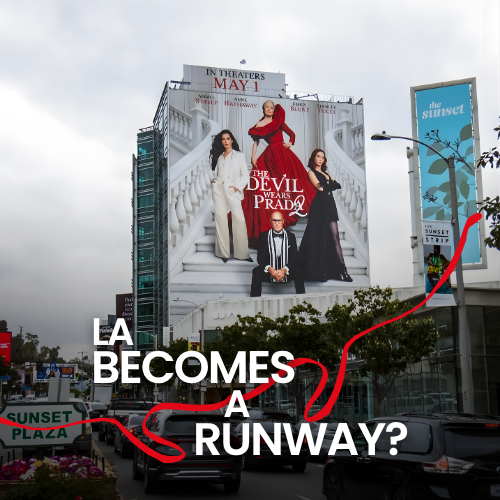
The Devil Wears Prada 2 campaign turns key locations like LA and JFK Airport into fashion runways, using OOH to merge film promotion with the language of high fashion.
Cultural Context: Fashion as Entertainment Ecosystem
Fashion and entertainment have become increasingly intertwined. Films are no longer just narratives—they are extensions of cultural industries, particularly fashion.
The original Devil Wears Prada succeeded not only as a story, but as a window into the fashion world. Its sequel inherits that expectation, entering a landscape where audiences engage with fashion through social media, events, and real-world experiences.
In this context, promoting the film requires more than traditional visibility. It demands immersion in the environments where fashion lives and evolves.

Insight: If Fashion Is the Story, the Media Must Dress Like It
The campaign is built on a clear strategic idea: the medium should reflect the message.
A film rooted in fashion cannot rely on static, conventional advertising. Instead, it must adopt the codes of the industry it represents—runways, exclusivity, and spectacle.
By turning OOH placements into runway-like experiences, the campaign aligns form and content. The city itself becomes an extension of the film’s narrative world.
Media Strategy: Owning High-Influence Locations
The choice of locations is central to the campaign’s effectiveness.
- Los Angeles represents the heart of the entertainment industry
- JFK Airport serves as a gateway for global travelers, influencers, and business audiences
These are not just high-traffic areas—they are high-influence environments. The audience passing through them includes tastemakers, media professionals, and culturally engaged consumers.
By placing the campaign in these spaces, the film positions itself within the same ecosystem as fashion shows and cultural events.
OOH here functions as both media and context, reinforcing the campaign’s runway concept.

Creative Execution: The City as Catwalk
The campaign reframes traditional OOH placements as elements of a runway.
Rather than isolated billboards, the executions work collectively to create a sense of movement and progression—mirroring the experience of a fashion show.
Key elements of the execution include:
- Sequential placements that guide the viewer through a visual narrative
- High-fashion imagery that echoes editorial aesthetics
- Clean, confident typography that aligns with luxury branding codes
In airport environments, this approach is particularly effective. Travelers move through space in a linear way, naturally experiencing the campaign as a sequence—much like watching models walk a runway.
Strategic Impact: Positioning Film as Cultural Event
By adopting the language of fashion, the campaign elevates the film beyond traditional movie marketing.
It positions The Devil Wears Prada 2 as:
- A cultural moment, not just a release
- A fashion event, not just a story
- An experience that begins before entering the theater
This approach increases anticipation and aligns the film with industries that thrive on exclusivity and hype.

Execution Insight: OOH as Environmental Storytelling
The campaign demonstrates how OOH can function as environmental storytelling rather than isolated messaging.
Instead of delivering a single impression, it creates a journey. Each placement contributes to a broader narrative that unfolds across physical space.
This is particularly relevant in transit hubs like JFK, where audiences are already moving and receptive to sequential experiences.
The result is a campaign that feels less like advertising and more like an installation.
Final Reflection: When Location Becomes Narrative
The Devil Wears Prada 2 campaign highlights a key evolution in OOH: location is no longer just about reach—it is about meaning.
By selecting environments that align with fashion and influence, and by designing executions that mimic runway dynamics, the campaign transforms media into narrative space.
In doing so, it reinforces a broader trend in entertainment marketing: the most effective campaigns don’t just promote content—they extend it into the real world.

Summary
The Devil Wears Prada 2 brings its fashion-first identity into the physical world by transforming Los Angeles streets and JFK Airport into immersive runway-inspired OOH experiences. The campaign positions the film not just as a cinematic release, but as a cultural fashion moment, aligning media placement with the industry’s most influential environments.
FAQs
What is the campaign about?
It is an OOH campaign promoting The Devil Wears Prada 2 by turning cities into fashion-inspired runways.
Where did it launch?
The campaign activated in Los Angeles and JFK Airport in New York.
What makes it innovative?
It transforms OOH placements into a runway experience, aligning media with the film’s fashion theme.
What was the strategic insight?
A fashion-driven film requires media that reflects the aesthetics and dynamics of the fashion industry.
FAQs about this campaign
What is the campaign about?
It is an OOH campaign promoting The Devil Wears Prada 2 by turning cities into fashion-inspired runways.
Where did it launch?
The campaign activated in Los Angeles and JFK Airport in New York.
What makes it innovative?
It transforms OOH placements into a runway experience, aligning media with the film’s fashion theme.
What was the strategic insight?
A fashion-driven film requires media that reflects the aesthetics and dynamics of the fashion industry.
Bring your idea to breakfast-time OOH
Explore formats that meet audiences in morning routines and commuter corridors.
Comments
Be the first to comment.