Quick Answer
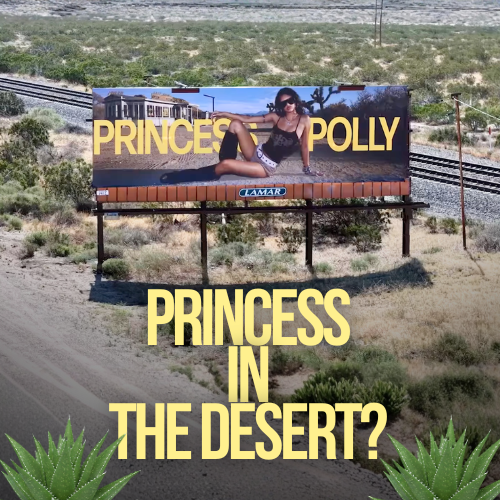
Princess Polly’s desert billboards turn remote landscapes into high-impact fashion statements, designed for both physical presence and social media amplification.
Cultural Context: The Rise of “Destination OOH”
OOH is no longer confined to urban density. Increasingly, brands are placing media in remote or unexpected locations—deserts, highways, and festival routes—turning geography into part of the creative idea.
This shift is driven by a new consumption behavior: content is no longer experienced only in situ. It is captured, shared, and redistributed across platforms like TikTok and Instagram.
In this context, a billboard is no longer just a placement—it is a backdrop, a prop, a piece of content waiting to happen.
For fashion brands, this evolution is particularly relevant. Visibility is no longer just about reach, but about aesthetic relevance.
Insight: If It’s Not Shareable, It Doesn’t Scale
Princess Polly’s audience—primarily Gen Z—does not interact with advertising in traditional ways. They don’t just see campaigns; they remix, repost, and reinterpret them.
The key insight is that physical media must be designed for digital afterlife. A billboard in the desert is not just for drivers passing by—it is for creators who will photograph it, film it, and distribute it.
This transforms OOH into a content engine rather than a static channel.
Media Strategy: Location as Amplification
The decision to place billboards in a desert environment is strategic.
Unlike urban clutter, where multiple stimuli compete for attention, the desert offers visual isolation. The billboard becomes the focal point, uninterrupted and highly legible.
At the same time, these locations often intersect with cultural moments—road trips, festivals, and events—where audiences are already primed to capture and share experiences.
This creates a dual-layered media effect:
- Physical reach through high-visibility roadside placements
- Digital amplification through user-generated content
The result is a campaign that extends far beyond its geographic footprint.
Creative Execution: Minimalism Meets Attitude
The phrase “standing on business in the desert” reflects a tone that is both confident and culturally fluent. It speaks directly to a digital-native audience without overexplaining itself.
Visually, the execution relies on bold, fashion-forward imagery paired with clean typography. The desert backdrop enhances contrast, allowing the creative to stand out without additional complexity.
Key characteristics of the execution include:
- Strong visual hierarchy for instant readability
- High-contrast color palettes against natural landscapes
- Styling that aligns with current fashion aesthetics
The simplicity is intentional. In a share-driven ecosystem, clarity and recognizability outperform complexity.
Strategic Impact: OOH as Social Currency
By designing OOH with shareability in mind, Princess Polly turns media into social currency. The billboard is not just an ad—it is a moment people want to document.
This approach delivers several advantages:
- Extended reach beyond paid media through organic sharing
- Cultural relevance by aligning with audience behavior
- Brand association with lifestyle moments rather than transactions
Importantly, the campaign blurs the line between advertising and content. When users capture and share the billboard, they become part of the distribution strategy.
Execution Insight: Fashion as Environment, Not Just Product
Rather than isolating the product, the campaign integrates it into a broader environment. The desert is not just a backdrop—it is part of the narrative.
This reflects a shift in fashion marketing from product-centric to context-centric storytelling. The question is no longer “what are we selling?” but “where does this brand live?”
By placing itself in unexpected, visually striking locations, Princess Polly reinforces its identity as a brand that exists within culture, not outside it.
Final Reflection: When OOH Is Designed for the Camera
Princess Polly’s desert billboards illustrate a key evolution in outdoor advertising: the primary audience is no longer just the passerby—it is the camera.
Campaigns are now designed with the assumption that they will be photographed, filmed, and shared. This requires a different creative discipline—one that prioritizes composition, contrast, and cultural tone.
In this model, OOH becomes the starting point of a much larger distribution system.
And in that system, location is no longer just placement—it is strategy.
Summary
Princess Polly leverages large-format desert billboards to create culturally relevant OOH moments that extend beyond location into social media. By placing bold visuals in unexpected environments, the brand transforms outdoor advertising into a hybrid of physical presence and digital virality, targeting a Gen Z audience attuned to aesthetic-driven discovery.
Sources
FAQs
What is the campaign about?
It is an OOH campaign using desert billboards to promote Princess Polly through visually striking placements.
Where did it launch?
The campaign appeared in desert roadside locations associated with travel and cultural events.
What makes it innovative?
It designs OOH specifically for social media amplification, turning billboards into shareable content.
What was the strategic insight?
Gen Z audiences extend the reach of campaigns by capturing and sharing visually compelling moments.
FAQs about this campaign
What is the campaign about?
It is an OOH campaign using desert billboards to promote Princess Polly through visually striking placements.
Where did it launch?
The campaign appeared in desert roadside locations associated with travel and cultural events.
What makes it innovative?
It designs OOH specifically for social media amplification, turning billboards into shareable content.
What was the strategic insight?
Gen Z audiences extend the reach of campaigns by capturing and sharing visually compelling moments.
Bring your idea to breakfast-time OOH
Explore formats that meet audiences in morning routines and commuter corridors.
Comments
Be the first to comment.