Quick Answer
Burger King disrupted marathon culture in Belgium with an OOH campaign that encouraged runners to quit, reframing success as participation rather than performance.
Cultural Context: The Tyranny of Performance in Sports
Modern sports culture is dominated by a singular narrative: push harder, go further, never quit. From elite athletes to amateur runners, the messaging is consistent—success is defined by endurance, sacrifice, and completion.
This ethos has been amplified by brands that frame sport as a test of limits, often glorifying pain and perseverance as necessary conditions for achievement.
However, this narrative can feel increasingly disconnected from everyday participants. For most marathon runners, the experience is not about winning, but about personal challenge, vulnerability, and, often, struggle.
This gap between idealized performance and lived reality creates space for a different kind of storytelling.

Insight: Most Runners Think About Quitting—But No One Says It
The campaign is built on an unspoken truth: at some point during a marathon, nearly every runner considers giving up.
Fatigue, doubt, and physical strain are not exceptions—they are universal moments within the experience. Yet traditional sports messaging ignores or suppresses these feelings.
Burger King identifies this tension and leans into it. Instead of motivating runners to continue, the campaign validates what they are already thinking.
This creates an immediate emotional connection, rooted not in aspiration, but in honesty.
Media Strategy: Context as the Message
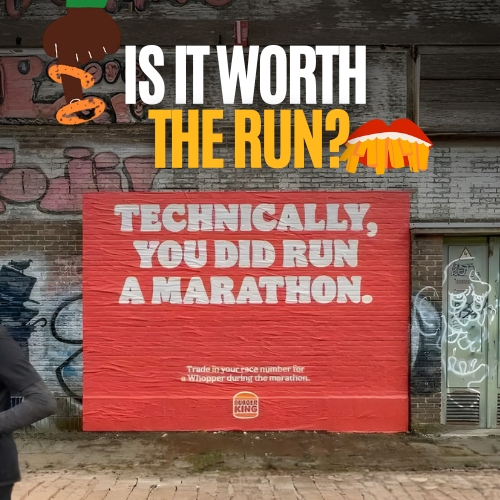
The campaign’s effectiveness lies in its precise contextual placement. Rather than broadcasting a generic message, Burger King integrates its communication directly into the marathon route.
As runners progress, the messaging evolves—mirroring their physical and emotional state at different stages of the race. Early messages are playful and ironic, while later ones become more empathetic, acknowledging fatigue and doubt.
This real-time alignment between message and mindset transforms OOH into a dynamic narrative system.
The medium is not just visible—it is relevant in the exact moment it is consumed.

Creative Execution: Rewriting the Language of Sport
The copy is deliberately stripped of epic tone and heroic language. Instead, it adopts a voice that feels conversational, honest, and slightly irreverent:
- “Starting is iconic. Finishing is optional.”
- “Your mom is already proud of you.”
- “Technically, you already ran a marathon.”
These lines invert the traditional rhetoric of sports marketing. Where most brands push for continuation, Burger King offers permission to stop.
The execution also includes a tangible incentive: runners could exchange their race bib for a Whopper. This gesture transforms quitting from failure into reward, reframing the act entirely.
Importantly, the humor is not dismissive—it is empathetic. The campaign does not mock runners; it acknowledges their effort in a more human way.
Strategic Contrast: Challenging Category Conventions
The campaign’s positioning becomes even more powerful when contrasted with dominant narratives in the category.
For example, Nike’s “Winning Isn’t Comfortable” campaign reinforces the traditional ethos of resilience and endurance, celebrating discomfort as a path to victory.
Burger King takes the opposite stance. Instead of glorifying struggle, it normalizes limitation.
This contrast is not accidental—it sharpens differentiation. By occupying the opposite end of the spectrum, Burger King ensures its message stands out in a saturated cultural space.

Strategic Impact: Humanizing Success
At its core, the campaign redefines what success looks like in sport.
Rather than focusing on completion, it celebrates participation. Instead of elevating extraordinary performance, it validates ordinary experience.
This shift has several implications:
- It broadens relevance beyond elite or highly committed athletes
- It creates emotional resonance through relatability
- It positions the brand as self-aware and culturally attuned
By aligning itself with a more human definition of achievement, Burger King strengthens its connection with everyday consumers.
Execution Insight: When Irreverence Meets Empathy
Burger King has a long history of irreverent marketing, but this campaign adds a layer of emotional intelligence.
The humor works because it is grounded in truth. The provocation—encouraging runners to quit—is balanced by a deeper message: showing up is already an accomplishment.
This balance is critical. Without empathy, the campaign could feel cynical. With it, the message becomes supportive, even if unconventional.

Final Reflection: Redefining Motivation in Brand Communication
Burger King’s marathon campaign demonstrates that motivation does not always require pressure. Sometimes, it requires permission.
By challenging deeply ingrained narratives around effort and success, the brand opens up a new space in sports marketing—one that prioritizes honesty over heroism.
In doing so, it not only captures attention, but reshapes how audiences think about achievement itself.
Summary
Burger King partnered with Happiness to launch an unconventional OOH campaign during the Ghent Marathon. By encouraging runners to abandon the race and rewarding them with a Whopper, the brand subverted traditional sports narratives and created a more human, relatable connection with participants.
Sources
FAQs
What is the campaign about?
It is an OOH campaign encouraging marathon runners to quit, reframing success as participation rather than completion.
Where did it launch?
The campaign took place during the Ghent Marathon in Belgium.
What makes it innovative?
It subverts traditional sports messaging by validating the idea of quitting instead of pushing endurance.
What was the strategic insight?
Most runners experience moments of doubt and consider quitting, but this is rarely acknowledged in sports marketing.
FAQs about this campaign
What is the campaign about?
It is an OOH campaign encouraging marathon runners to quit, reframing success as participation rather than completion.
Where did it launch?
The campaign took place during the Ghent Marathon in Belgium.
What makes it innovative?
It subverts traditional sports messaging by validating the idea of quitting instead of pushing endurance.
What was the strategic insight?
Most runners experience moments of doubt and consider quitting, but this is rarely acknowledged in sports marketing.
Bring your idea to breakfast-time OOH
Explore formats that meet audiences in morning routines and commuter corridors.

Comments
Be the first to comment.