Quick Answer
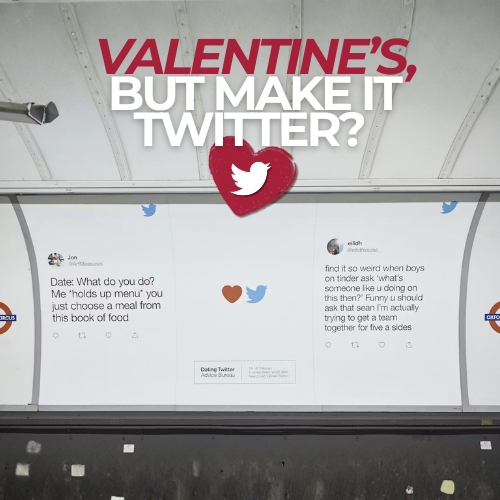
Twitter’s Valentine’s Day OOH campaign transformed chaotic, funny user tweets into large-scale billboards—proving that authenticity and internet humor.
Roses Are Red. Tweets Are Unhinged.
Roses are red, violets are blue—Twitter once turned chaotic Valentine’s tweets into billboards, and somehow… it worked perfectly.
At a time when most brands leaned into glossy romance, cinematic love stories, or carefully crafted manifestos, Twitter did something radically simple: it printed the internet.
No CGI.
No dramatic music.
No sweeping declarations about love.
Just real, slightly unhinged user tweets—blown up across massive outdoor placements.
At a time when most brands leaned into glossy romance, cinematic love stories, or carefully crafted manifestos, Twitter did something radically simple: it printed the internet.

The Internet as the Big Idea
The brilliance of the campaign was that there was no traditional “big idea.” The insight was straightforward: the internet is funny. Especially on Valentine’s Day.
Instead of pretending love is always poetic, Twitter embraced the awkwardness, sarcasm, heartbreak, and oversharing that define the platform. Tweets about being ghosted. Tweets about loving your dog more than your date. Tweets that felt too honest to say out loud—until they were suddenly twelve feet tall on a billboard.
By scaling digital chaos into physical space, Twitter blurred the line between online culture and the real world. The street became a timeline.

Why It Worked
First, authenticity. These weren’t polished copy lines written in a boardroom. They were user-generated posts—raw and relatable.
Second, contrast. While other Valentine’s campaigns relied on predictable romantic tropes, Twitter’s OOH felt disruptive because it didn’t try to romanticize anything.
Third, shareability. People photographed the billboards because they recognized themselves in them. The campaign fed back into the platform, creating a loop between physical and digital media.

Bring This Energy Back
In today’s era of hyper-produced campaigns and algorithm-chasing content, there’s something refreshing about that simplicity.
Sometimes the smartest move isn’t adding more layers—it’s amplifying what already exists.
Now that X has evolved the brand, one can’t help but think: bring this kind of OOH back.
Because sometimes the internet doesn’t need polishing.
It just needs a billboard.

Summary
By simply amplifying real tweets about love and heartbreak, Twitter created a Valentine’s campaign that felt raw, culturally accurate, and instantly shareable. It showed that sometimes the strongest creative idea is letting the internet speak for itself.
FAQs
What made Twitter’s Valentine’s OOH campaign different?
It used real user tweets instead of traditional brand copy, embracing humor and imperfection.
Why did user-generated content work in OOH?
Because it felt authentic and culturally accurate, contrasting with polished advertising clichés.
How did the campaign bridge digital and physical media?
By turning online tweets into physical billboards, it made the street feel like an extension of the timeline.
FAQs about this campaign
What made Twitter’s Valentine’s OOH campaign different?
It used real user tweets instead of traditional brand copy, embracing humor and imperfection.
Why did user-generated content work in OOH?
Because it felt authentic and culturally accurate, contrasting with polished advertising clichés.
How did the campaign bridge digital and physical media?
By turning online tweets into physical billboards, it made the street feel like an extension of the timeline.
Bring your idea to breakfast-time OOH
Explore formats that meet audiences in morning routines and commuter corridors.
Comments
Be the first to comment.