Quick Answer
Spotify’s RapCaviar launched billboards reading “Hip-Hop Needs New Leaders” across major cities, then invited users to vote inside the app for the artist.
A Provocation in Public Space
The message was simple and direct: “Hip-Hop Needs New Leaders.”
Appearing on billboards in major cities worldwide, the phrase immediately triggered conversation. Was it criticism? A generational call-out? A marketing stunt? Social media quickly amplified the debate, with fans and artists weighing in on who truly represents the future of the genre.
Rather than clarifying the message immediately, Spotify allowed speculation to build. The ambiguity was strategic. In an industry driven by identity and influence, leadership is a sensitive and powerful concept.

From Debate to Platform Participation
Days later, the company revealed that the OOH intervention was part of a broader initiative titled “Leaders of the Next Generation.” The campaign connects physical media, digital conversation, and in-product interaction into one cohesive narrative.
Spotify selected eight artists identified by its hip-hop editorial and artist partnerships teams as representatives of the next era:
-
Doechii (Tampa)
-
Baby Keem (Las Vegas)
-
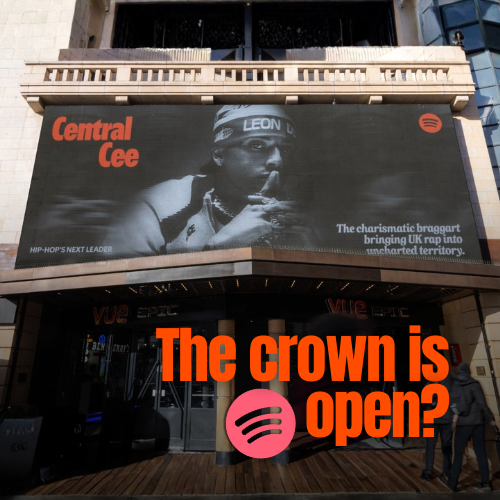
Central Cee (London)
-
GloRilla (Memphis)
-
BigXthaPlug (Dallas)
-
Lil Tecca (New York)
-
Rod Wave (St. Petersburg)
-
Sexyy Red (St. Louis)
Each artist appeared on billboards in their hometown, reinforcing geographic identity as part of the storytelling. The city becomes context. Leadership starts locally before scaling globally.

Turning Culture Into Clicks
Beyond outdoor and social, Spotify integrated the conversation directly into its product. Inside the app, users could access the campaign’s official playlist and vote once per day for the artist they believe will define the next decade of hip-hop. Voting remained open until 9:00 a.m. PT on Monday, March 2.
This mechanic transforms passive consumption into active participation. Instead of merely streaming music, users engage in shaping a cultural narrative.
From a marketing perspective, the strategy is clear: OOH sparks conversation, social amplifies it, and the app captures it. The full funnel exists within a single ecosystem.

The Future of Music Marketing
The campaign reflects a broader shift in music marketing. Cultural debates are no longer external to platforms — they are integrated into them. By linking billboards to in-app action, Spotify not only promotes emerging artists but also drives traffic, retention, and measurable engagement.
In a genre built on voice and influence, asking audiences to choose the next leader is more than promotion — it’s participation.
And in this case, the street didn’t just talk. It voted.

Summary
With a bold OOH statement, Spotify — through its editorial brand RapCaviar — ignited debate about the future of hip-hop. The campaign evolved into “Leaders of the Next Generation,” combining global billboards, social media conversation, and daily in-app voting to transform cultural discussion into measurable engagement.
Sources
FAQs
What is “Hip-Hop Needs New Leaders”?
It is a global OOH campaign by Spotify’s RapCaviar that sparked debate about the future of hip-hop.
How did Spotify extend the campaign beyond billboards?
The company integrated a daily voting system inside its mobile app, allowing users to choose the next generation leader.
How many artists were selected?
Eight emerging artists were chosen to represent the next generation.
FAQs about this campaign
What is “Hip-Hop Needs New Leaders”?
It is a global OOH campaign by Spotify’s RapCaviar that sparked debate about the future of hip-hop.
How did Spotify extend the campaign beyond billboards?
The company integrated a daily voting system inside its mobile app, allowing users to choose the next generation leader.
How many artists were selected?
Eight emerging artists were chosen to represent the next generation.
Bring your idea to breakfast-time OOH
Explore formats that meet audiences in morning routines and commuter corridors.
Comments
Be the first to comment.