Quick Answer
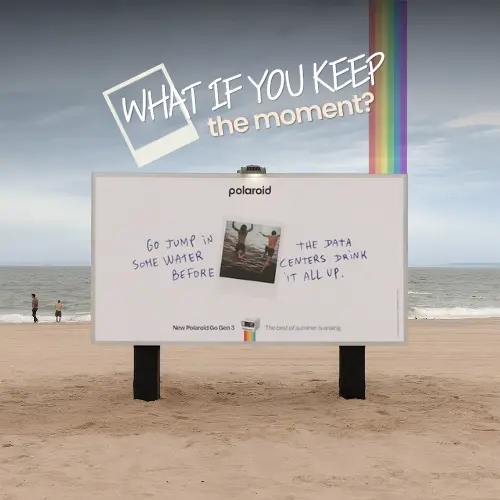
Polaroid’s Coney Island billboard uses outdoor advertising to question our relationship with screens, AI consumption, and the environmental cost of digital life, while reinforcing the value of living in the moment.
When A Billboard Says What Everyone Is Thinking
Great outdoor advertising often succeeds because it captures a feeling people already have but rarely see expressed publicly.
Polaroid’s latest billboard in Coney Island does exactly that.
The campaign takes a growing cultural frustration—our increasing dependence on screens—and turns it into a conversation about how we spend our time.
Rather than promoting a product directly, the billboard asks a bigger question: what are we missing while we remain permanently online?
A Message Bigger Than Photography
At first glance, the campaign appears to be about living in the moment.
But beneath the surface lies a broader commentary on contemporary digital behavior.
The creative references the rapidly growing infrastructure behind AI technologies, particularly the expansion of data centers and their environmental footprint.
By connecting personal screen habits with larger systemic consequences, the billboard expands the conversation beyond individual behavior.
Why The Creative Feels Powerful
The strongest outdoor campaigns often rely on simplicity.
There are no complicated explanations, technical statistics, or lengthy arguments.
The message is immediate, emotionally charged, and easy to understand.
Its effectiveness comes from allowing viewers to complete the thought themselves.
The audience becomes an active participant in the meaning of the campaign.

Polaroid’s Natural Brand Positioning
Few brands are better positioned to deliver this message than Polaroid.
For decades, the company has represented tangible memories, physical experiences, and moments captured in real life rather than through algorithms.
In a world increasingly dominated by feeds, recommendations, and synthetic content, Polaroid stands for something refreshingly human.
The campaign feels authentic because it aligns perfectly with the brand’s heritage.
OOH As A Cultural Medium
Outdoor advertising has a unique ability to participate in public conversations.
Unlike digital ads that appear inside personalized ecosystems, billboards exist in shared spaces.
Everyone sees the same message at the same time.
That public visibility gives campaigns like this a cultural weight that is difficult to replicate elsewhere.
Turning Frustration Into Art
Part of the campaign’s appeal comes from its emotional honesty.
Many people feel overwhelmed by the speed, volume, and permanence of online life.
The billboard channels that collective exhaustion into a simple visual statement.
Instead of offering a solution, it offers a pause—a moment to reflect on what deserves our attention.

Final Reflection: Less Online, More Alive
Polaroid’s Coney Island billboard demonstrates how outdoor advertising can address complex cultural issues without becoming complicated.
By connecting AI infrastructure, environmental concerns, and digital habits through a simple message, the campaign achieves something increasingly rare: it makes people stop and think.
In doing so, it reinforces one of Polaroid’s most enduring ideas—that some of life’s best moments happen when we look up from the screen and experience them for ourselves.

Summary
In one of the most talked-about OOH executions online, Polaroid uses a simple but provocative billboard to spark reflection about modern digital culture. By referencing the growing environmental impact of AI data centers while promoting real-world experiences over endless scrolling, the campaign transforms frustration with online life into a powerful brand statement that feels both culturally relevant and unmistakably Polaroid.
Sources
FAQs
What is the main message of the campaign?
The billboard encourages people to spend less time online and more time experiencing life in the real world.
Why does the campaign mention AI data centers?
It highlights the growing environmental impact associated with the infrastructure that powers modern AI technologies.
Why is Polaroid a credible brand for this message?
Polaroid has long been associated with real-world experiences, physical memories, and living in the moment.
What makes the billboard effective?
Its simple message encourages reflection while connecting a personal habit to a larger cultural and environmental conversation.
FAQs about this campaign
What is the main message of the campaign?
The billboard encourages people to spend less time online and more time experiencing life in the real world.
Why does the campaign mention AI data centers?
It highlights the growing environmental impact associated with the infrastructure that powers modern AI technologies.
Why is Polaroid a credible brand for this message?
Polaroid has long been associated with real-world experiences, physical memories, and living in the moment.
What makes the billboard effective?
Its simple message encourages reflection while connecting a personal habit to a larger cultural and environmental conversation.
Bring your idea to breakfast-time OOH
Explore formats that meet audiences in morning routines and commuter corridors.



Comments
Be the first to comment.