Quick Answer
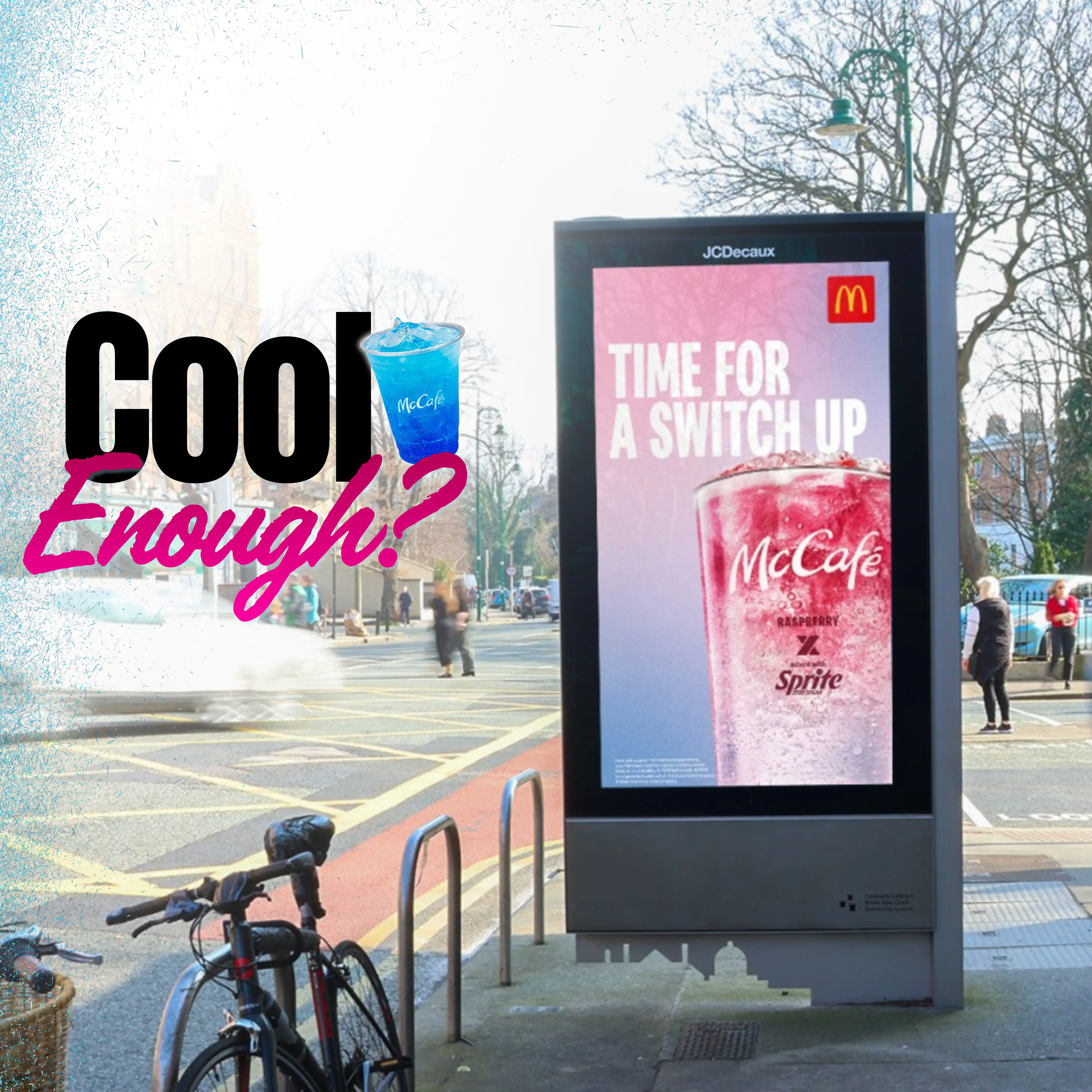
McDonald’s is using Out of Home to keep its Summer Beverages range visible throughout the season, combining broad-reach formats with a weather-triggered programmatic DOOH layer. The campaign uses 6 Sheets, roadside, retail digital formats and Digipanels planned around restaurant proximity and moments when cold refreshment becomes more relevant.
Creative Context: Summer Is a Season of Movement
Summer changes how people move through the day.
Routines shift, days stretch, journeys become less predictable and weather can quickly influence what people want, where they go and what they choose to buy.
For McDonald’s, that makes Out of Home a natural fit for its latest Summer Beverages activity.
The campaign keeps the beverage range visible across the season while leaning into the moments when cold refreshment feels more immediately relevant.
It is a strong example of how OOH can support both everyday brand presence and timely consumer action.
OOH Strategy: More Than a Weather-Triggered Campaign
The strength of the campaign lies in how McDonald’s uses OOH across several layers.
This is not simply a weather-triggered digital activation.
It is a wider OOH campaign that combines broadcast visibility, contextual relevance and programmatic precision.
The broader media presence keeps McDonald’s available in memory throughout summer.
The responsive digital layer then helps the brand show up more strongly when the moment becomes especially relevant.
Broadcast Presence: Keeping the Brand Close to Mind
OOH remains a powerful one-to-many medium, especially for a brand like McDonald’s.
Many purchase decisions in the category are quick, habitual or impulse-led.
A cold drink purchase may happen in the moment, but the brand that benefits is often the one already closest to mind before that moment arrives.
That is why broad seasonal visibility matters.
OOH helps McDonald’s maintain presence before the consumer has even decided what they want.
Format Mix: 6 Sheets, Roadside and Retail Digital
Across the campaign, McDonald’s is using a mix of 6 Sheets, roadside and retail digital formats.
The classic element includes restaurant-targeted 6 Sheets, helping keep the brand visible close to purchase opportunities.
Roadside formats support awareness during daily movement and travel.
The retail digital layer adds visibility close to restaurant buys, reinforcing the message near moments of potential action.
Together, these formats help build a strong base of seasonal brand availability.
Proximity Planning: Connecting Media to Restaurant Access
Restaurant proximity is a key part of the planning logic.
For quick-service restaurants, OOH becomes more effective when it appears close to locations where consumers can act on the message.
McDonald’s can use OOH to remind people of the Summer Beverages range while they are already near a restaurant, retail environment or travel route.
This reduces the distance between awareness and action.
It also makes the creative feel more useful because the product is nearby and easy to access.
Programmatic Layer: Digipanels Respond to the Weather
Layered onto the broader activity is a more responsive use of digital OOH.
The Digipanel element adds a weather-triggered programmatic layer designed to go live when temperatures reach 15 degrees or higher at selected times of day.
This is where the campaign becomes especially interesting from a planning perspective.
The weather trigger is not the whole strategy.
It is a precision layer within a wider plan.
Contextual Relevance: When the Temperature Rises
When the temperature rises, Summer Beverages naturally move closer to the consumer’s immediate consideration set.
Cold refreshment becomes more desirable, more useful and more connected to the world around the audience.
By using programmatic delivery, McDonald’s can lean into those moments with messaging that feels timely and relevant.
The campaign uses context in a simple but effective way.
It responds when weather, timing and consumer behavior are more closely aligned.
Using Digital OOH to Make the Wider Campaign Work Harder
The campaign does not ask digital OOH to replace the scale of the wider media plan.
Instead, it uses digital OOH to make the broader campaign work harder.
Broadcast builds the base.
Format choice supports visibility across different environments.
Contextual thinking makes the message feel more relevant.
Programmatic delivery sharpens the campaign around the moments when the audience is most likely to respond.
Why Programmatic OOH Works Best as a Layer
The opportunity in programmatic OOH is not to reduce campaigns to isolated triggers or narrow moments.
OOH is still at its strongest when it builds fame, familiarity and mental availability at scale.
The programmatic layer adds another dimension.
It gives advertisers the ability to respond with greater precision when the moment is right.
For McDonald’s, that means maintaining broad summer visibility while becoming more contextually relevant when warm weather increases beverage appeal.
Creative Simplicity and Timing
McDonald’s has long understood the value of creative simplicity, proximity and timing in Out of Home.
Its campaigns work because they are easy to recognize, easy to process and placed in environments where the brand already has a role in people’s lives.
This campaign continues that approach.
It uses the full canvas of OOH to maintain presence across summer while using data-led delivery to connect with moments of heightened relevance.
Why the Campaign Works
The campaign works because it balances scale with precision.
First, broad OOH visibility keeps McDonald’s Summer Beverages available in memory across the season.
Second, restaurant proximity helps connect the message to moments where consumers can act.
Third, weather-triggered Digipanels allow the campaign to become more relevant when temperatures rise.
Finally, the strategy shows that reach and programmatic precision are not opposing ideas.
They are complementary parts of a stronger OOH plan.
Final Reflection: Reach, Context and Timing Working Together
McDonald’s Summer Beverages activity shows how OOH can support the full journey from awareness to consideration to action.
The lesson for advertisers is not simply that digital OOH can be activated by the weather.
The bigger point is that broad reach and smarter precision work best together.
Reach still matters.
Context matters.
Timing matters.
Proximity matters.
When these elements are planned as one connected system, OOH becomes more than a visibility channel.
It becomes a flexible platform for seasonal relevance and real-world action.
Summary
McDonald’s Summer Beverages activity shows how OOH can combine broad visibility with smarter contextual precision. The campaign uses restaurant-targeted 6 Sheets, roadside and retail digital formats to build seasonal mental availability, while Digipanels add a programmatic layer triggered when temperatures reach 15 degrees or higher at selected times of day. Rather than relying only on weather-triggered media, McDonald’s uses programmatic DOOH as a precision layer within a wider OOH plan, balancing reach, proximity, timing and relevance.
Sources
FAQs
What is McDonald’s Summer Beverages OOH campaign?
It is an Out of Home campaign promoting McDonald’s Summer Beverages range through 6 Sheets, roadside, retail digital formats and weather-triggered Digipanels.
How does the weather-triggered element work?
The programmatic Digipanel layer is designed to activate when temperatures reach 15 degrees or higher at selected times of day.
Why is OOH effective for summer beverage campaigns?
OOH reaches people during real-world movement, travel and purchase moments, making it effective for impulse-led categories such as cold beverages.
What is the main planning lesson from the campaign?
The campaign shows that broad OOH reach and programmatic precision can work together, with broadcast presence building memory and contextual triggers sharpening relevance.
FAQs about this campaign
What is McDonald’s Summer Beverages OOH campaign?
It is an Out of Home campaign promoting McDonald’s Summer Beverages range through 6 Sheets, roadside, retail digital formats and weather-triggered Digipanels.
How does the weather-triggered element work?
The programmatic Digipanel layer is designed to activate when temperatures reach 15 degrees or higher at selected times of day.
Why is OOH effective for summer beverage campaigns?
OOH reaches people during real-world movement, travel and purchase moments, making it effective for impulse-led categories such as cold beverages.
What is the main planning lesson from the campaign?
The campaign shows that broad OOH reach and programmatic precision can work together, with broadcast presence building memory and contextual triggers sharpening relevance.
Bring your idea to breakfast-time OOH
Explore formats that meet audiences in morning routines and commuter corridors.

Comments
Be the first to comment.