Quick Answer
McDonald’s transformed its iconic “I’m Lovin’ It” slogan into personalized Valentine’s billboards, turning mass-reach OOH into intimate public love notes.
From Global Slogan to Personal Confession
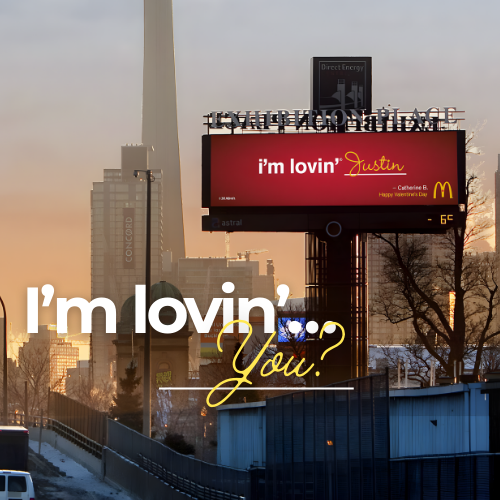
The McDonald's “I’m Lovin’ [Name]” Valentine’s campaign is a masterclass in contextual intimacy. Instead of promoting a product, the brand repurposed its world-famous tagline—I’m Lovin’ It—into a framework for public declarations of affection.
By replacing the generic “it” with handwritten-style names like Justin, Oliver, and Myriam, the campaign shifted from broadcast messaging to something that felt startlingly personal. A corporate slogan became a love note.
The brilliance lies in localization. The equity of “Lovin’” remains intact, but its meaning becomes fluid—no longer about fries or burgers, but about someone specific.

Design That Balances Scale and Intimacy
Visually, the execution is minimalist but psychologically sharp.
First, the brand signal: the unmistakable red background and the Golden Arches ensure instant recognition—even at highway speed or from dense urban vantage points near landmarks like the CN Tower.
Second, the handwritten humanism: the names appear in a yellow cursive font that contrasts with the bold brand typography. That break in visual language mimics a signature. It feels less like an ad and more like a message written just for someone.
The tension between corporate precision and handwritten warmth is what makes the creative resonate.

Cultural and Linguistic Agility
The campaign also adapts linguistically. In bilingual markets like Canada, executions transition seamlessly from English (“I’m Lovin’ Oliver”) to French (“C’est Myriam que j’m”), preserving cultural nuance while maintaining brand consistency.
That flexibility elevates the work beyond a template. It demonstrates technical and strategic sensitivity to place.

OOH as Emotional Infrastructure
By placing these billboards in high-traffic urban centers, McDonald’s effectively hijacked public infrastructure to enable private connection. The skyline became a timeline of affection.
This isn’t product advertising.
It’s brand utility.
By stepping into the aspirational space of romance and emotional expression, McDonald’s repositions itself—not as the hero of the message, but as its enabler.
And in doing so, it proves that sometimes the strongest brand move isn’t about selling something.
It’s about saying something—for someone.
Summary
By replacing “it” with real names, McDonald’s redefined its global tagline as a vehicle for romance and emotional utility. The minimalist execution elevated OOH from product advertising to cultural participation.
Sources
FAQs
What is the “I’m Lovin’ [Name]” campaign?
A Valentine’s OOH activation that replaces “it” in McDonald’s iconic slogan with real names, turning billboards into public love messages.
Why is the campaign strategically strong?
It transforms a global brand asset into a personalized emotional tool while maintaining immediate brand recognition.
How does design contribute to the impact?
The contrast between bold brand typography and handwritten-style names injects warmth into a highly structured visual identity.
Why does localization matter in this campaign?
Adapting the language to different regions preserves authenticity and cultural relevance.
What does this say about modern OOH?
That it can move beyond product promotion and become a platform for emotional and community expression.
FAQs about this campaign
What is the “I’m Lovin’ [Name]” campaign?
A Valentine’s OOH activation that replaces “it” in McDonald’s iconic slogan with real names, turning billboards into public love messages.
Why is the campaign strategically strong?
It transforms a global brand asset into a personalized emotional tool while maintaining immediate brand recognition.
How does design contribute to the impact?
The contrast between bold brand typography and handwritten-style names injects warmth into a highly structured visual identity.
Why does localization matter in this campaign?
Adapting the language to different regions preserves authenticity and cultural relevance.
What does this say about modern OOH?
That it can move beyond product promotion and become a platform for emotional and community expression.
Bring your idea to breakfast-time OOH
Explore formats that meet audiences in morning routines and commuter corridors.
Comments
Be the first to comment.