Quick Answer
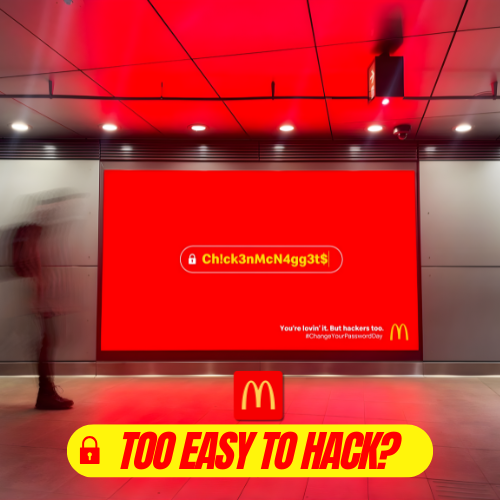
McDonald’s Netherlands launched an awareness campaign for Change Your Password Day, using breach data showing how often product-related passwords.
When brand familiarity becomes a security risk
To mark Change Your Password Day, McDonald’s Netherlands launched a campaign focused on one of the most common digital vulnerabilities: weak and predictable passwords. The activation draws attention to real data showing that many consumers rely on simple, familiar words — including popular food items and brand names — when creating login credentials.
According to breach tracking platform Have I Been Pwned, the password “bigmac” has appeared in leaked datasets more than 110,000 times, revealing how frequently consumers rely on recognizable brand references when creating passwords.
Data turns awareness into storytelling
Rather than presenting cybersecurity as a technical issue, the campaign uses relatable brand associations to make the message accessible. Alongside “bigmac,” the dataset includes other McDonald’s product names such as “frenchfries,” “happymeal,” and “mcnuggets,” each appearing thousands of times across compromised databases.
By highlighting these examples, McDonald’s reframes familiar menu items as a reminder of how easily predictable passwords can expose personal data.

Connecting everyday behaviour to digital safety
The campaign builds on the insight that people often choose passwords linked to memory and emotion — names of loved ones, hobbies, favourite brands, or daily routines. While easy to recall, these choices significantly increase vulnerability to cyberattacks and data breaches.
Global cybersecurity organisations consistently warn that reused or overly simple passwords remain one of the primary causes of compromised accounts, often leading to financial and privacy risks.
Turning Change Your Password Day into a brand moment
Change Your Password Day is observed annually as a reminder to update and strengthen login credentials. McDonald’s Netherlands uses the occasion to expand the conversation beyond routine security advice, encouraging consumers to reflect on their digital habits through a culturally familiar lens.
By leveraging its own brand recognition as an example, McDonald’s positions itself as both participant and messenger, using humour and relatability to increase engagement with a serious topic.

Why the campaign stands out
The activation demonstrates how brands can use real data and cultural relevance to address broader social issues. Instead of promoting products, McDonald’s focuses on consumer wellbeing, aligning brand awareness with digital responsibility.
The campaign also reflects a growing marketing trend where brands move beyond transactional messaging to participate in conversations that impact everyday life — including online safety and personal data protection.
Summary
McDonald’s Netherlands turned cybersecurity awareness into a culturally relevant brand message by revealing how frequently consumers use familiar brand names as passwords. Using data from Have I Been Pwned, the campaign highlights the risks of predictable login credentials while aligning the brand with digital responsibility.
Sources
FAQs
What is Change Your Password Day?
It is an annual awareness initiative encouraging people to update and strengthen their passwords to improve cybersecurity.
What data did McDonald’s use in the campaign?
The campaign used breach data from Have I Been Pwned showing how frequently product-related passwords appear in leaked datasets.
Why are weak passwords dangerous?
Predictable or reused passwords make it easier for hackers to access personal accounts and sensitive information.
What is Have I Been Pwned?
It is a platform that collects data from security breaches and allows users to check if their credentials have been exposed.
FAQs about this campaign
What is Change Your Password Day?
It is an annual awareness initiative encouraging people to update and strengthen their passwords to improve cybersecurity.
What data did McDonald’s use in the campaign?
The campaign used breach data from Have I Been Pwned showing how frequently product-related passwords appear in leaked datasets.
Why are weak passwords dangerous?
Predictable or reused passwords make it easier for hackers to access personal accounts and sensitive information.
What is Have I Been Pwned?
It is a platform that collects data from security breaches and allows users to check if their credentials have been exposed.
Bring your idea to breakfast-time OOH
Explore formats that meet audiences in morning routines and commuter corridors.
Comments
Be the first to comment.