Quick Answer
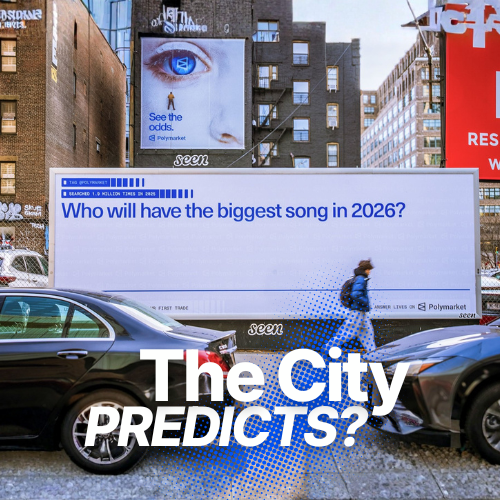
Polymarket launched a question-driven OOH campaign that mirrors the real-world predictions users trade on its platform, turning billboards into conversation starters.
OOH that asks instead of tells
Polymarket operates at the intersection of prediction, culture, and real-world events, allowing users to trade on outcomes across politics, sports, and entertainment. Its out-of-home campaign reflects that same mechanic, posing the kinds of questions people already speculate on daily—only this time, they appear on walls, posters, and billboards.
Rather than delivering a message, the OOH invites interpretation. It asks passers-by to think, react, agree, disagree, and most importantly, talk.

Public space as a social feed
This approach reflects a broader shift in how brands are using outdoor media. Increasingly, OOH is functioning like a physical version of social media—built not just to be seen, but to provoke response.
Blank or minimal layouts, open questions, and intentionally ambiguous prompts are becoming tools to encourage participation. The billboard is no longer the final product; it’s the trigger.
Controversy as a distribution strategy
Polymarket’s work sits alongside other recent examples where brands have deliberately embraced discomfort or confusion to generate reach. One of the most notable was AI startup Friend, whose CEO spent over $1 million covering all five boroughs of New York with intentionally vague and provocative messaging.
The result wasn’t just attention in the streets, but a wider global debate that played out online—amplified through screenshots, commentary, and media coverage. What some viewed as “vandalism” or disruption became the engine for distribution.

The real campaign lives online
In this model, the physical execution is only the first step. The real impact depends on whether the message travels beyond the street and into feeds, group chats, and timelines.
OOH becomes a catalyst rather than a container. Its success is measured less by impressions on location and more by how often it’s photographed, shared, debated, and reframed online.
Why this approach works now
As advertising formats start to look increasingly similar, differentiation shifts from features to conversation. Polymarket’s OOH doesn’t explain the platform—it behaves like it.
By asking the same questions users trade on, the brand reinforces its core proposition while inviting the public to engage on their own terms. In a crowded media landscape, that openness becomes a strength.

OOH as cultural infrastructure
Campaigns like this signal a change in how outdoor advertising is being valued. The billboard isn’t just media space; it’s cultural infrastructure—a place where ideas are introduced and then carried elsewhere by the audience.
For brands willing to relinquish control and invite interpretation, OOH becomes one of the most powerful starting points for modern brand storytelling.
Summary
Polymarket’s latest out-of-home work strips advertising down to a simple but powerful device: the same open-ended questions users bet on every day. By placing these prompts in public space, the brand transforms OOH into a participatory medium—one that behaves less like traditional advertising.
Sources
FAQs
What is Polymarket?
Polymarket is a platform where users trade on the outcomes of real-world events such as politics, sports, and culture.
What makes this OOH campaign different?
Instead of delivering a brand message, the campaign poses open-ended questions that invite debate and participation.
Why are brands using provocative OOH more often?
Because public space increasingly acts like social media, where conversation, controversy, and sharing drive reach.
FAQs about this campaign
What is Polymarket?
Polymarket is a platform where users trade on the outcomes of real-world events such as politics, sports, and culture.
What makes this OOH campaign different?
Instead of delivering a brand message, the campaign poses open-ended questions that invite debate and participation.
Why are brands using provocative OOH more often?
Because public space increasingly acts like social media, where conversation, controversy, and sharing drive reach.
Bring your idea to breakfast-time OOH
Explore formats that meet audiences in morning routines and commuter corridors.
Comments
Be the first to comment.