Quick Answer
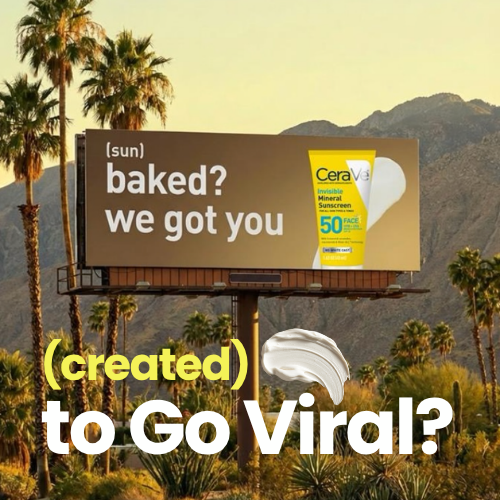
Brands are using AI to create fictional billboard concepts tied to Coachella, turning OOH into a social-first format that capitalizes on the festival’s cultural visibility without physical placements.
Cultural Context: Coachella as an Advertising Stage
Coachella has evolved far beyond a music festival. It functions as a global stage for fashion, culture, and increasingly, brand visibility.
Every year, the roads leading to the festival grounds in the California desert become lined with billboards from major brands—fashion, tech, beauty, and entertainment—all competing for attention during one of the most photographed events of the year.
These billboards are not just media placements; they are cultural signals. Being “at Coachella” has become shorthand for relevance.
However, the cost and exclusivity of these placements limit participation to a small group of brands. This constraint has unintentionally created space for a new kind of entry.

Insight: If You Can’t Be There, You Can Still Be Seen
The key insight behind this trend is that presence is no longer physical—it is perceptual.
Audiences engaging with Coachella content are primarily doing so through social media. They are not experiencing the billboards firsthand; they are seeing them through curated posts, influencer content, and brand feeds.
This creates an opportunity: if a billboard looks real and feels culturally aligned, it can achieve the same impact without existing in physical space.
AI becomes the enabling tool, allowing brands to generate high-quality, hyper-realistic billboard visuals that mimic the Coachella aesthetic.

Media Strategy: From Physical OOH to Social OOH
This trend represents a shift from traditional out-of-home to what could be defined as “social OOH.”
Instead of investing in physical placements, brands create billboard-style visuals designed specifically for digital platforms. These assets are then distributed through Instagram, LinkedIn, and other social channels.
The strategy delivers several advantages:
- Cost efficiency: No production or media buying required
- Speed: Concepts can be created and published in real time
- Scalability: Multiple variations can be tested quickly
In this model, the billboard is no longer a medium—it is a format.

Creative Execution: Hyper-Realism Meets Cultural Timing
The AI-generated billboards closely replicate the visual language of real Coachella placements:
- Desert backdrops with warm, sunlit tones
- Large-format typography designed for distance
- Minimalist layouts with bold, culturally relevant messaging
What differentiates these executions is their tone. Many brands use humor, self-awareness, or commentary to stand out, acknowledging the fact that the billboard is not real.
Others lean into aspirational aesthetics, blurring the line between fiction and reality.
This ambiguity is part of the appeal. It invites engagement and discussion—“Is this real?” becomes part of the interaction.

Strategic Impact: Democratizing Cultural Participation
One of the most significant implications of this trend is accessibility.
Traditionally, participating in Coachella’s OOH landscape required substantial budgets and logistical planning. AI-generated billboards remove those barriers, allowing smaller brands and individuals to join the conversation.
This democratization shifts the competitive dynamic:
- Visibility is no longer tied solely to spend
- Creativity becomes the primary differentiator
- Speed and cultural awareness drive relevance
At the same time, it challenges the value of physical OOH exclusivity, as digital replicas begin to compete for attention.

Execution Insight: The Rise of “Spec Advertising” as Content
Many of these billboard concepts are not official campaigns, but speculative executions—ideas created to demonstrate creativity rather than promote an actual media buy.
This reflects a broader trend in the industry:
- Creatives and brands using social platforms as portfolios
- Concepts functioning as content
- Ideas gaining traction without traditional approval processes
In this context, AI is not just a production tool—it is a distribution enabler. It allows ideas to exist and spread without needing to be built in the real world.
Tension: When Simulation Competes With Reality
While the trend opens new opportunities, it also raises questions about authenticity.
If audiences cannot easily distinguish between real and AI-generated placements, the line between campaign and concept becomes blurred.
For brands that invest heavily in physical OOH, this could dilute perceived exclusivity. For others, it represents a chance to compete on equal footing.
The balance between these dynamics will likely define how the trend evolves.

Final Reflection: When OOH Becomes an Idea, Not a Place
The rise of AI-generated Coachella billboards signals a fundamental shift in how out-of-home is understood.
OOH is no longer limited to physical structures. It has become a visual language that can exist independently of location.
In this new model, the value of a billboard is not just where it stands, but how it spreads.
And in a culture driven by visibility and shareability, sometimes the most effective billboard is the one that was never actually there.

Summary
The annual cultural gravity of Coachella has sparked a new wave of speculative advertising, where brands design AI-generated billboards and share them on social media as if they were real. This emerging trend reframes OOH as a conceptual and shareable format, allowing companies—from startups to global players—to participate in the festival’s visibility without the cost of physical media buys.
Sources
FAQs
What is the trend about?
It involves brands creating AI-generated billboard visuals inspired by Coachella and sharing them on social media.
Where did it originate?
The trend is tied to Coachella’s cultural influence and the prominence of billboard advertising around the festival.
What makes it innovative?
It transforms OOH into a digital-first format, removing the need for physical placements.
Why are brands doing this?
To participate in a high-visibility cultural moment without the cost of traditional OOH media buying.
Is this replacing real billboards?
Not entirely, but it is challenging their exclusivity by offering a more accessible alternative.
FAQs about this campaign
What is the trend about?
It involves brands creating AI-generated billboard visuals inspired by Coachella and sharing them on social media.
Where did it originate?
The trend is tied to Coachella’s cultural influence and the prominence of billboard advertising around the festival.
What makes it innovative?
It transforms OOH into a digital-first format, removing the need for physical placements.
Why are brands doing this?
To participate in a high-visibility cultural moment without the cost of traditional OOH media buying.
Is this replacing real billboards?
Not entirely, but it is challenging their exclusivity by offering a more accessible alternative.
Bring your idea to breakfast-time OOH
Explore formats that meet audiences in morning routines and commuter corridors.

Comments
Be the first to comment.