
Quick Answer
Back Market’s “Downgrade Now” campaign uses OOH and integrated media to challenge upgrade culture, promoting refurbished tech as a more human and intentional choice.
Cultural Context: Fatigue in the Age of Constant Upgrades
The tech industry has long operated on a predictable cycle: newer, faster, better. Annual launches and incremental improvements have conditioned consumers to equate upgrading with progress.
However, this model is showing signs of strain. Consumers are increasingly aware that many upgrades deliver marginal benefits while contributing to financial and environmental costs.
At the same time, the rise of AI-generated content and algorithmic optimization has created a cultural landscape that feels repetitive and impersonal. The promise of innovation is beginning to blur into uniformity.
This dual fatigue—technological and cultural—creates fertile ground for a counter-narrative.
Insight: People Don’t Want More Tech—They Want Better Relationships With It
The campaign is built on a shift in mindset: consumers are not rejecting technology, but they are questioning its role in their lives.
The pressure to constantly upgrade is less about utility and more about expectation. Back Market identifies that many users would prefer a more balanced, intentional relationship with their devices.
By reframing “downgrade” as a positive choice, the brand challenges the assumption that progress must always mean more.
This insight moves the conversation from performance to perspective.
Media Strategy: Integrated Reach With Cultural Precision
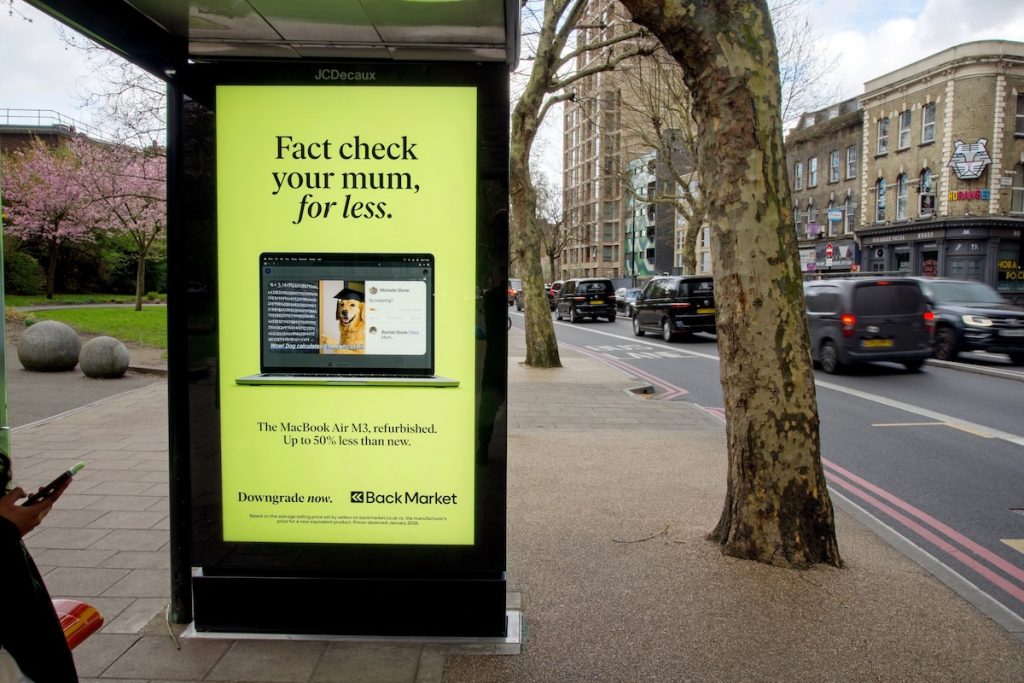
“Downgrade Now” runs across TV, VOD, OOH, social, and audio, ensuring both scale and frequency across multiple touchpoints.
However, the strategic weight sits heavily on OOH. In cities like London and Birmingham, the campaign uses rotating executions to maintain freshness and encourage repeat engagement.
OOH becomes the primary canvas for cultural commentary—placing sharp, irreverent messages directly into everyday environments.
The broader international rollout across the US, France, Spain, and Germany reinforces the universality of the insight, while allowing for localized resonance.
Creative Execution: Satire as Strategy
The campaign’s creative strength lies in its use of satire. Instead of competing with traditional tech advertising, it dismantles it.
Each execution targets a specific aspect of modern digital culture:
- An iPhone displaying an AI-generated muscular frog with the line: “Scroll past the slop, for less”
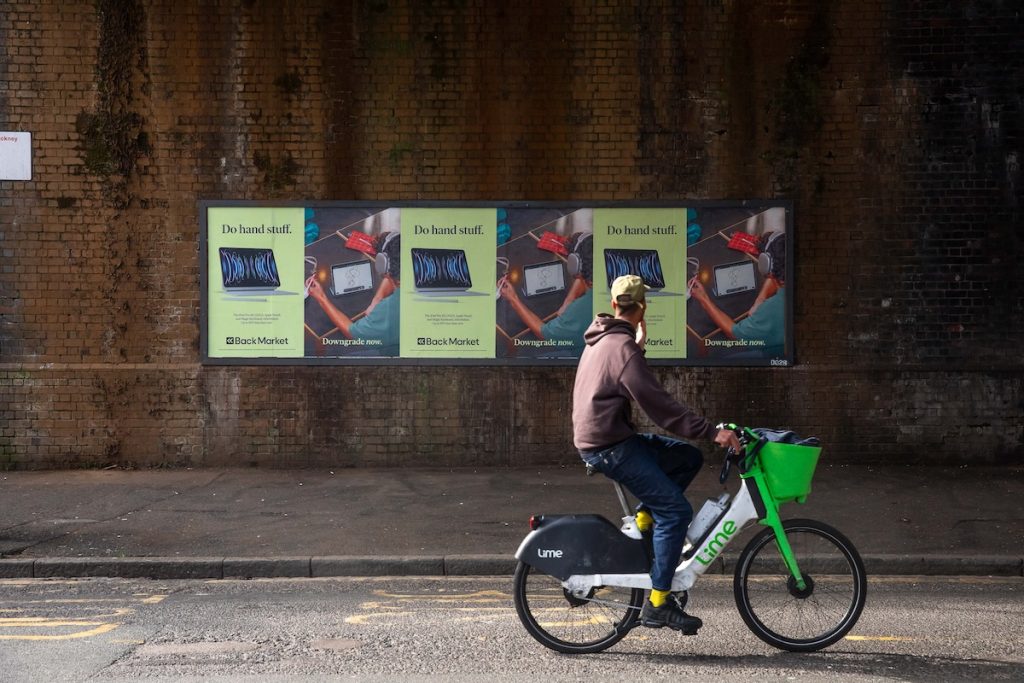
- An iPad and Apple Pencil paired with: “Do hand stuff”
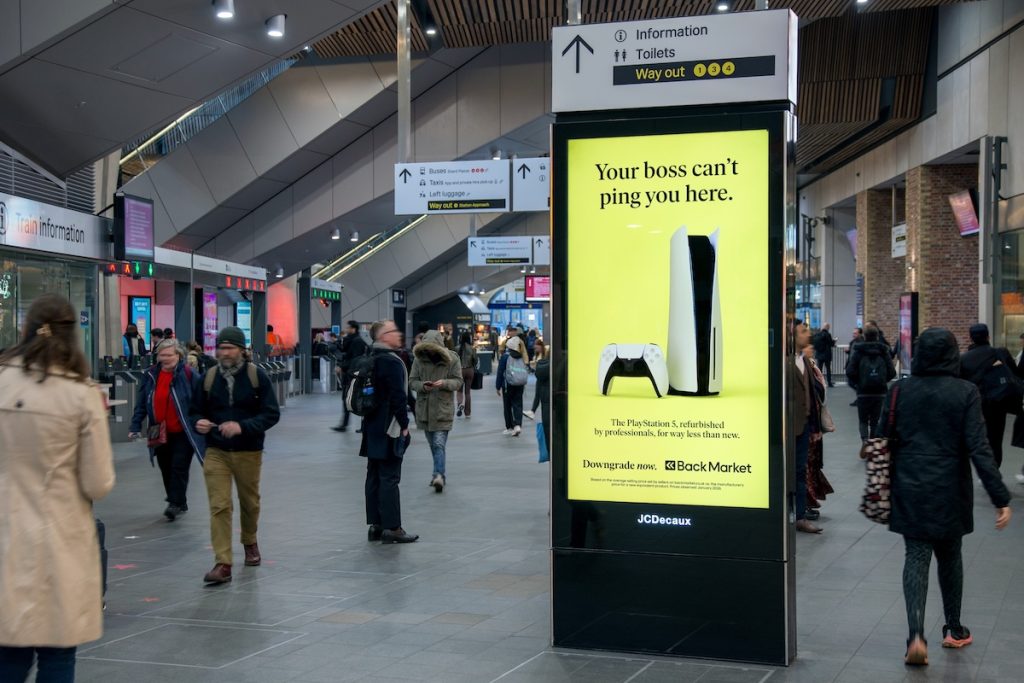
- A PlayStation 5 visual stating: “Your boss can’t ping you here”
These lines operate on multiple levels. They are humorous and provocative, but also deeply reflective of current frustrations—content overload, work intrusion, and the absurdity of AI-generated visuals.
Importantly, the campaign avoids technical language entirely. There are no specs, no performance claims, no feature breakdowns.
The product is present, but the message is cultural.
Strategic Impact: Repositioning Through Opposition
Back Market’s approach is not to out-innovate competitors, but to outframe them.
By positioning itself against upgrade culture, the brand creates a clear point of differentiation. It becomes the alternative to an entire system of thinking, rather than just another option within it.
This delivers several strategic advantages:
- Clarity in a crowded category
- Relevance through cultural alignment
- Memorability through tonal distinctiveness
The campaign also aligns with broader trends in sustainability and conscious consumption, reinforcing the practical benefits of refurbished tech without making them the primary message.
Execution Insight: Humor With Intent
The humor in “Downgrade Now” is not random—it is targeted. Each execution taps into a specific tension within modern tech culture.
This precision ensures that the campaign resonates beyond surface-level amusement. It invites recognition, not just reaction.
The rotating OOH format further enhances this effect, encouraging audiences to encounter multiple variations and build a cumulative understanding of the campaign’s perspective.
Final Reflection: When Less Becomes the Message
Back Market’s “Downgrade Now” campaign reflects a broader shift in consumer mindset. In a world defined by constant updates and optimization, restraint becomes a form of differentiation.
By rejecting the default narrative of progress, the brand positions itself as both culturally aware and strategically bold.
The campaign suggests that the future of tech marketing may not be about convincing people to want more—but helping them feel comfortable wanting less.
Summary
Back Market launches “Downgrade Now,” an integrated campaign spanning OOH, TV, social and audio that reframes refurbished technology as a cultural response to upgrade fatigue. By rejecting spec-driven messaging and parodying AI-generated content, the brand positions itself as a human-centered alternative in a market dominated by optimization and sameness.
Sources
FAQs
What is the campaign about?
It is an integrated campaign encouraging consumers to rethink upgrade culture and consider refurbished tech.
Where did it launch?
The campaign ran in the UK, including London and Birmingham, with extensions across multiple global markets.
What makes it innovative?
It uses satire and cultural commentary to challenge traditional tech marketing narratives.
What was the strategic insight?
Consumers are experiencing fatigue from constant upgrades and are seeking a more balanced relationship with technology.
What media channels were used?
The campaign includes OOH, TV, VOD, social media, and audio.
FAQs about this campaign
What is the campaign about?
It is an integrated campaign encouraging consumers to rethink upgrade culture and consider refurbished tech.
Where did it launch?
The campaign ran in the UK, including London and Birmingham, with extensions across multiple global markets.
What makes it innovative?
It uses satire and cultural commentary to challenge traditional tech marketing narratives.
What was the strategic insight?
Consumers are experiencing fatigue from constant upgrades and are seeking a more balanced relationship with technology.
What media channels were used?
The campaign includes OOH, TV, VOD, social media, and audio.
Bring your idea to breakfast-time OOH
Explore formats that meet audiences in morning routines and commuter corridors.


Comments
Be the first to comment.