Quick Answer
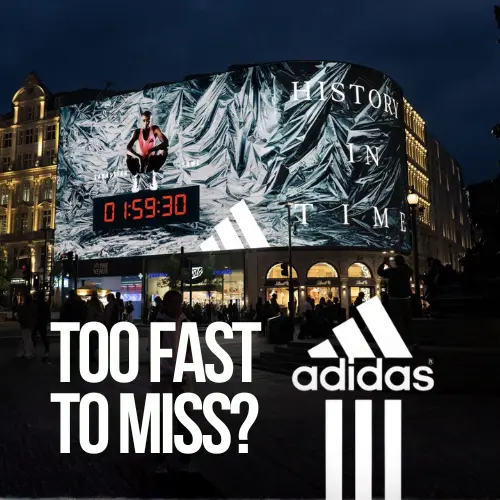
adidas launched a real-time campaign within hours of a major sports event, combining paid social across Europe with OOH in London to capture peak cultural relevance.
Cultural Context: Speed Has Become the New Competitive Advantage
In modern sports marketing, relevance is no longer measured in weeks or even days—it is measured in hours.
Major sporting moments generate global attention spikes that peak quickly and decay just as fast. Brands that wait too long risk becoming commentary rather than part of the moment.
This shift has redefined campaign planning. Instead of fixed timelines, brands must now build systems capable of reacting in real time.
For global sports brands like adidas, this is not optional—it is expected.

Insight: The Value of a Moment Is Highest Before It Becomes Content
The campaign is built on a critical insight: once a sports moment is widely shared, analyzed, and memed, its commercial value begins to decline.
To maximize impact, brands must insert themselves while the moment is still unfolding in public consciousness.
That requires:
- Pre-planned frameworks
- Rapid creative production
- Immediate media deployment
- Cross-market coordination
The challenge is not just speed—it is meaningful speed.
Media Strategy: Social for Scale, OOH for Cultural Weight
The campaign combines two complementary channels:
- Paid social across multiple European markets for rapid, scalable distribution
- OOH in London for physical, high-impact presence
This dual approach is strategically strong.
Social delivers immediacy and reach, ensuring the campaign appears in feeds while the moment is still trending.
OOH, on the other hand, adds legitimacy. It signals that the brand is not just reacting online, but committing real-world media to the moment.
Together, they create a layered effect:
- Digital speed
- Physical permanence
- Cultural amplification

Creative Execution: Built in Real Time
One of the most significant aspects of this campaign is that the creative was finalized on the same day.
This is not just a production detail—it is the core of the idea.
Real-time campaigns succeed when they feel native to the moment, not pre-scripted or opportunistic. That requires creative teams to:
- Interpret the event instantly
- Develop a clear message without overthinking
- Execute with precision under time pressure
The result is communication that feels alive, not manufactured.
Strategic Impact: From Sponsor to Participant
Many brands sponsor sports events, but fewer become part of the conversation.
By reacting within hours, adidas shifts its role from observer to participant.
This creates several advantages:
- Higher engagement due to contextual relevance
- Stronger emotional connection with audiences
- Increased shareability across platforms
- Perception of brand agility and cultural awareness
The campaign does not just leverage the moment—it contributes to it.

Execution Insight: Speed Requires Infrastructure, Not Just Talent
Reactive marketing often appears spontaneous, but it is usually the result of significant preparation.
To deliver at this level, adidas likely relied on:
- Pre-approved creative frameworks
- Streamlined approval processes
- Close collaboration between brand, media, and production teams
- Flexible media buying capabilities
Without this infrastructure, speed becomes risk. With it, speed becomes advantage.
OOH’s Role: Making Digital Moments Tangible
In a real-time campaign, OOH plays a unique role.
While social captures attention instantly, OOH extends the life of the idea and anchors it in the physical world.
Seeing a reactive message on a London billboard shortly after a major sports event reinforces the sense that the brand is truly “there,” not just posting online.
It transforms a fleeting digital moment into something more concrete and memorable.
Final Reflection: Real-Time Marketing Is Now a System, Not a Tactic
adidas’ campaign reflects a broader evolution in marketing. Real-time response is no longer a novelty—it is a capability brands must build into their operations.
The brands that win are not necessarily the fastest, but the most prepared to be fast.
By combining speed, scale, and strategic media integration, adidas demonstrates how to turn a live sports moment into immediate brand relevance.
In today’s landscape, showing up quickly is not enough. You have to show up well—and at scale.

Summary
adidas executed a reactive, real-time campaign following a major sporting moment, deploying creative across paid social in multiple European markets and OOH in London within hours. The activation demonstrates how speed, coordination, and media integration can transform live events into immediate brand presence.
Sources
FAQs
What is the campaign about?
It is a real-time adidas campaign launched within hours of a major sports event across social and OOH.
Where did it launch?
The campaign ran across multiple European markets on social media, with OOH placements in London.
What makes it innovative?
The speed of execution—creative was developed and deployed the same day as the event.
What was the strategic insight?
Sports moments lose value quickly, so brands must act while attention is at its peak.
Which brand executed the campaign?
The campaign was delivered by adidas and its media teams.
FAQs about this campaign
What is the campaign about?
It is a real-time adidas campaign launched within hours of a major sports event across social and OOH.
Where did it launch?
The campaign ran across multiple European markets on social media, with OOH placements in London.
What makes it innovative?
The speed of execution—creative was developed and deployed the same day as the event.
What was the strategic insight?
Sports moments lose value quickly, so brands must act while attention is at its peak.
Which brand executed the campaign?
The campaign was delivered by adidas and its media teams.
Bring your idea to breakfast-time OOH
Explore formats that meet audiences in morning routines and commuter corridors.

Comments
Be the first to comment.