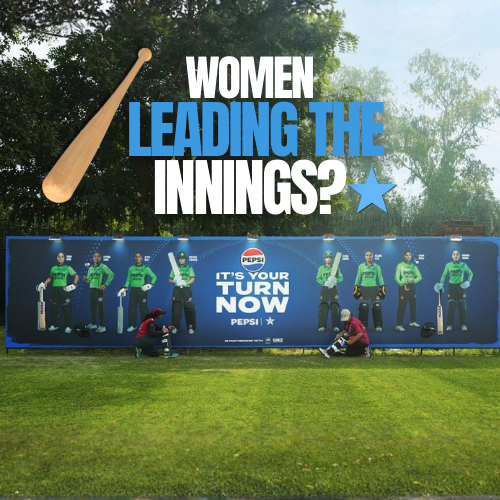
In Pakistan, where conservative norms still discourage millions of women from participating in sports, Pepsi has stepped forward with one of its most culturally impactful statements yet. The “It’s Your Turn Now” billboard publicly invites women to play cricket — a sport woven into the national identity but historically out of reach for women due to stigma, discrimination and lack of proper equipment.
A billboard that breaks silence in a cricket-obsessed nation
Cricket in Pakistan is more than a game — it is tradition, pride, and emotion. Yet for decades, women have been sidelined from this cultural cornerstone. Many are told playing sports is improper. Others who persist must use men’s cricket equipment because gear designed specifically for women is often unavailable.
Pepsi’s billboard challenges this inequality directly. With the assertive message “It’s Your Turn Now”, the brand reframes women not as outsiders — but as rightful players.
A bold cultural stance in a country undergoing social change
While discussions around women’s empowerment are growing in Pakistan, the act of publicly supporting women in sports remains rare. The billboard does more than advertise — it takes a side. It becomes a public declaration of equality placed directly in the streets where social norms are negotiated.
For women and girls who have long waited for visibility, the message becomes both validation and invitation.

Using OOH as a tool for representation and advocacy
The billboard’s design centers a confident female cricketer, bat in hand, standing with conviction. This visual alone disrupts deeply embedded cultural expectations. It signals:
- Women belong in this sport.
- Women deserve their own equipment and support systems.
- Women should not need permission to participate.
- Women’s participation is not taboo — it is progress.
The medium amplifies the message: public space should include and empower women too.
“It’s Your Turn Now”: a statement for an entire generation
For young girls who love cricket but face barriers at home or in school, seeing themselves represented on a large billboard is revolutionary. Pepsi isn’t simply acknowledging them — it is encouraging them to step forward.
The campaign transforms a billboard into a rallying cry: take your turn, claim your space, rewrite the rules.

Pepsi steps beyond sponsorship into cultural leadership
Pepsi has long supported cricket in Pakistan. But this campaign moves from brand sponsorship into cultural advocacy. It addresses inequality openly and uses one of the world’s biggest platforms — OOH — to spark conversation and inspire change.
By championing women at a moment when visibility is crucial, Pepsi aligns itself with a future in which cricket belongs to everyone.
Final Thoughts
Pepsi’s “It’s Your Turn Now” billboard is more than creative advertising — it is a statement of courage and cultural evolution. In a society where women’s sports have often been overshadowed, the message reclaims space, inspires confidence, and pushes the national conversation forward.
For women across Pakistan, this billboard is more than encouragement. It is permission to play — and a reminder that the field is theirs too.

FAQs about this campaign
What is the ‘It’s Your Turn Now’ billboard?
A bold OOH activation by Pepsi Pakistan encouraging women to play cricket, despite longstanding cultural taboos restricting women’s participation in sports.
Why is the campaign significant in Pakistan?
Because many women still face social criticism for playing sports, and even lack access to cricket equipment designed for them. The campaign challenges these barriers directly.
What issue does Pepsi highlight?
That women’s cricket remains underrepresented, under-resourced, and culturally discouraged — yet millions of women wish to play.
How does the billboard empower women?
By publicly declaring that women deserve equal access to the sport and should step confidently into spaces traditionally dominated by men.
Why use OOH instead of a traditional ad?
OOH offers bold visibility in public space, making the message unavoidable and symbolically reclaiming public space for women.
Bring your idea to breakfast-time OOH
Explore formats that meet audiences in morning routines and commuter corridors.