Quick Answer
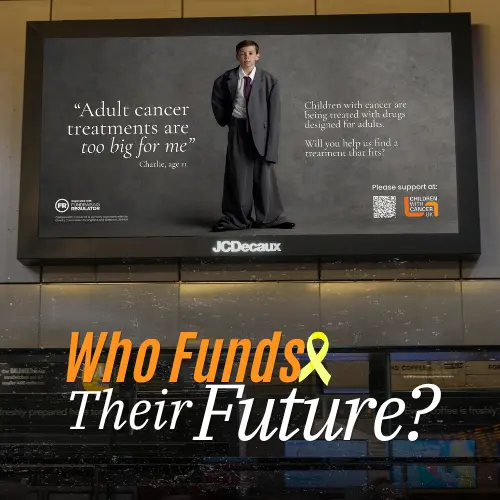
Children with Cancer UK and Earnies launched “Too Big,” an integrated awareness and fundraising campaign that uses oversized clothing worn by real children with cancer to highlight the fact that only 2% of cancer research funding is dedicated to children and young people.
Creative Strategy: Making An Invisible Injustice Impossible To Ignore
Children with Cancer UK’s latest campaign tackles a difficult reality with a remarkably simple idea.
Only 2% of cancer research funding is dedicated to children and young people.
Created by Earnies, the campaign uses oversized clothing as a visual metaphor for the fact that many childhood cancer patients receive treatments originally designed for adults.
The campaign is titled “Too Big”, and every creative execution reinforces that central idea.
If treatments are too big, then everything else should be too.
Real Children At The Centre Of The Story
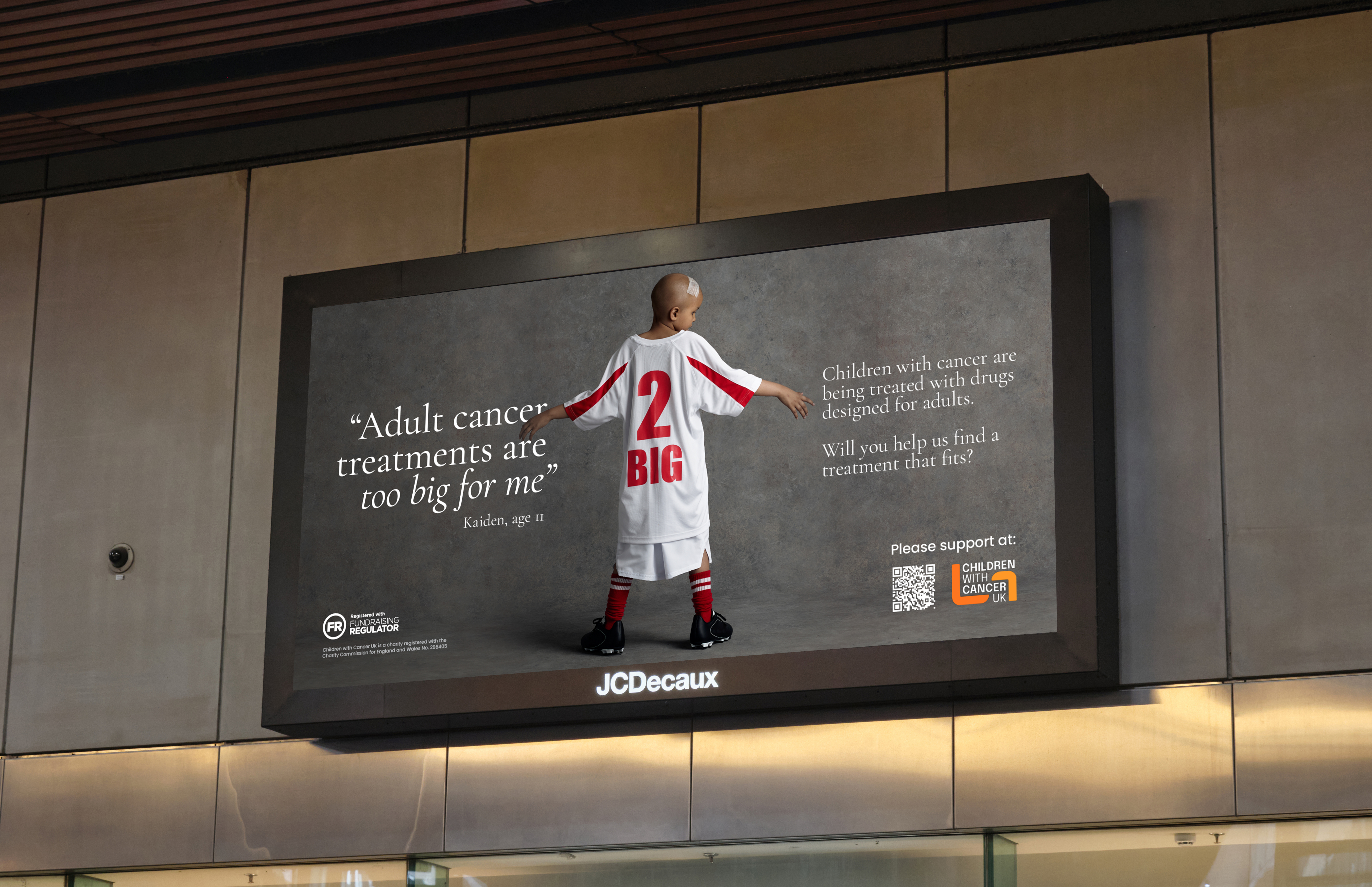
The campaign features seven children who have received or are currently receiving treatment for childhood cancer.
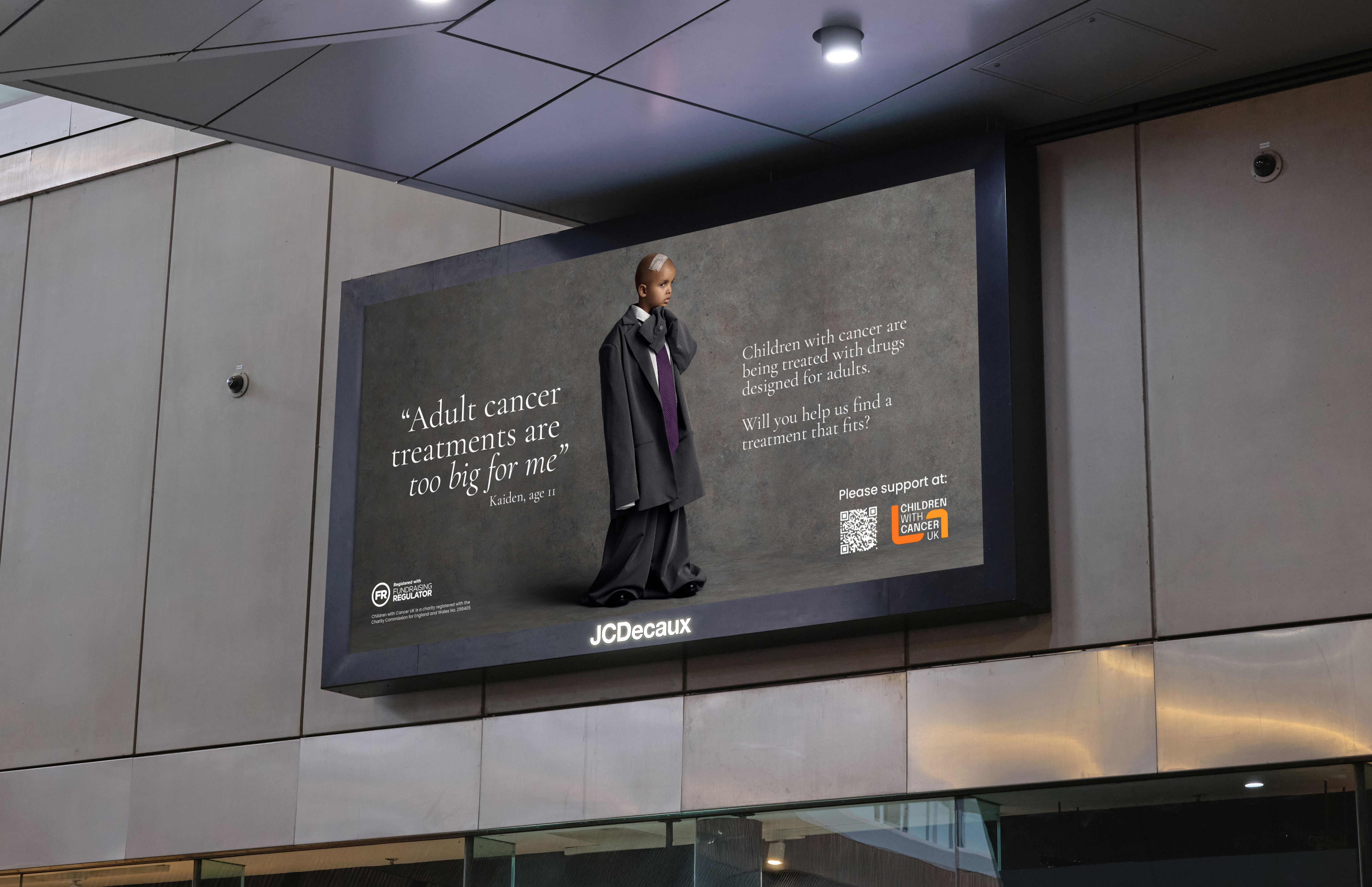
Each child appears wearing clothing dramatically larger than their size, including football kits, pyjamas, business suits, and medical gowns.
The imagery immediately communicates vulnerability while highlighting the mismatch between childhood cancer needs and available treatments.
Rather than relying on statistics alone, the campaign turns data into a deeply human story.
The oversized outfits create an emotional connection that audiences can instantly understand.
The Symbolism Behind The Oversized Clothing
The campaign’s visual device reflects a difficult medical reality.
Many treatments used for childhood cancers were originally developed for adults.
As a result, children can face significant long-term side effects including fertility issues, reduced mobility, hearing loss, growth complications, dental problems, and heart conditions.
By making clothing physically too large, the campaign visualizes a system that often feels too large for the children it is supposed to serve.
The metaphor is simple, but its impact is profound.
A Powerful Launch Through Football Culture
The campaign debuted through one of football’s most emotional traditions: the mascot walkout.
Before Everton faced Sunderland, 11-year-old Kaiden Edwards stepped onto the pitch wearing an oversized football shirt displaying the words “2 BIG.”
The image was impossible to ignore.
One child, swallowed by an adult-sized shirt, became a symbol of thousands of children facing treatments not designed specifically for them.
The activation took place on what would have been Bradley Lowery’s fifteenth birthday, adding further emotional significance to the moment.
OOH Strategy: Bringing The Message To Public Space
Following the football activation, the campaign expanded into outdoor advertising with a major takeover of London Bridge Station.
The scale of OOH proved particularly effective because it amplified the oversized creative concept while exposing millions of people to the funding gap at the heart of the campaign.
Building Momentum Beyond Awareness
“Too Big” is designed as a long-term platform rather than a single campaign moment.
Additional activations are planned throughout 2026, with a larger national rollout expected during Childhood Cancer Awareness Month in September.
The campaign aims not only to increase awareness but also to inspire fundraising and support for childhood cancer research.
By connecting emotional storytelling with a clear societal issue, the work creates opportunities for sustained engagement.
Why The Campaign Works
The strongest social impact campaigns often make complex problems feel instantly understandable.
“Too Big” succeeds because audiences grasp the message before reading a single statistic.
The oversized clothing communicates inequality, vulnerability, and urgency in one visual gesture.
Combined with real stories and real children, the campaign avoids abstraction and creates genuine empathy.
Final Reflection: When Scale Becomes A Call To Action
Children with Cancer UK and Earnies have created a campaign that transforms a funding statistic into something impossible to overlook.
By placing real children at the centre of the work and using scale as both metaphor and creative device, “Too Big” turns awareness into emotional understanding.
The campaign reminds audiences that childhood cancer is not simply a medical challenge—it is also a research challenge, a funding challenge, and ultimately a societal responsibility.
Summary
Created by Earnies for Children with Cancer UK, “Too Big” transforms scale into a powerful symbol of inequality in childhood cancer treatment and research. Featuring real children wearing oversized clothing and supported by high-profile activations including football partnerships and a London Bridge Station OOH takeover, the campaign aims to drive awareness, fundraising, and long-term behavioural change around childhood cancer research funding.
Sources
FAQs
What is the “Too Big” campaign about?
The campaign highlights that only 2% of cancer research funding is dedicated to children and young people.
Why are the children wearing oversized clothes?
The oversized clothing symbolizes the reality that many childhood cancer treatments were originally designed for adults.
Who created the campaign?
The campaign was developed by Earnies for Children with Cancer UK.
Where has the campaign appeared?
The campaign launched through a football activation and later expanded with an OOH takeover at London Bridge Station.
FAQs about this campaign
What is the “Too Big” campaign about?
The campaign highlights that only 2% of cancer research funding is dedicated to children and young people.
Why are the children wearing oversized clothes?
The oversized clothing symbolizes the reality that many childhood cancer treatments were originally designed for adults.
Who created the campaign?
The campaign was developed by Earnies for Children with Cancer UK.
Where has the campaign appeared?
The campaign launched through a football activation and later expanded with an OOH takeover at London Bridge Station.
Bring your idea to breakfast-time OOH
Explore formats that meet audiences in morning routines and commuter corridors.
Comments
Be the first to comment.