Quick Answer
The Mummy campaign used large-scale OOH stunts in India, including a giant mummy on a truck and interactive billboards, to turn everyday streets into a live horror experience.
Cultural Context: Horror Marketing Thrives on Physical Presence
Horror as a genre relies heavily on atmosphere, anticipation, and the disruption of normality.
While digital trailers and posters can build awareness, the most effective horror campaigns often extend into real-world experiences—where audiences are less prepared and more emotionally reactive.
In densely populated cities like Mumbai and Chennai, everyday routines are predictable. That predictability becomes the perfect canvas for disruption.
The more familiar the setting, the stronger the shock when something feels “off.”

Insight: Fear Is Stronger When It Feels Unplanned
The campaign is built on a core psychological truth: fear intensifies when it appears outside expected contexts.
Audiences expect horror inside cinemas or on screens. They do not expect it at traffic signals or during daily commutes.
By placing a giant mummy in real city environments, the campaign collapses the boundary between fiction and reality.
This creates a moment of uncertainty: is this part of the city, or something else?
That ambiguity is where engagement happens.
Media Strategy: From Billboard to Urban Spectacle
The campaign uses a multi-layered OOH approach across cities:
- A moving stunt: a giant mummy bound to a truck navigating Mumbai streets
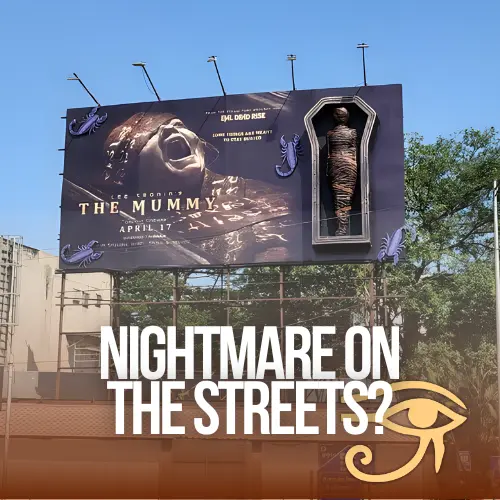
- Static billboards: featuring sarcophagus visuals and emerging figures
- Transformative executions: bandages unwrapping across surfaces in Chennai
This combination ensures both reach and depth:
- Mobility increases visibility across multiple neighborhoods
- Static placements reinforce recall
- Interactive or evolving visuals sustain attention
OOH becomes not just media, but narrative infrastructure.
Creative Execution: Turning Scale Into Suspense
The centerpiece of the campaign—the giant mummy tied to a truck—is designed for maximum visual disruption.
Its scale makes it impossible to ignore, while its placement in everyday traffic creates contrast.
Supporting executions build on the same idea:
- A mummy sealed in a sarcophagus mounted on a billboard
- Bandages appearing to unravel across surfaces
These visuals create the illusion that the entity is not contained—it is spreading.
This continuity across formats turns separate placements into a unified story.
Strategic Impact: Making the Audience Part of the Scene
Unlike traditional advertising, this campaign does not position the audience as observers. It places them inside the narrative.
Commuters, pedestrians, and drivers become participants simply by encountering the installations.
This generates:
- Immediate attention in physical space
- Organic social sharing through captured moments
- Increased memorability due to emotional reaction
The campaign effectively converts public curiosity into distribution.

Execution Insight: Mobility Extends Storytelling
The use of a moving truck is particularly strategic.
Unlike static billboards, it introduces unpredictability. The mummy can appear anywhere, at any time, across different parts of the city.
This creates a sense of presence rather than placement.
It also increases the likelihood of viral moments, as different audiences encounter and document the stunt from multiple perspectives.
Final Reflection: When OOH Becomes Part of the Horror
The Mummy campaign demonstrates how out-of-home can evolve from messaging into experience.
By bringing horror into the real world, it taps into a deeper emotional layer—one that cannot be replicated through screens alone.
The campaign does not just promote the film. It extends its universe into everyday life.
And in doing so, it reinforces a powerful idea:
The most effective horror is not what you watch—it is what you feel might be real.
Summary
The Mummy was promoted through an immersive OOH campaign in India that transformed public spaces into extensions of the film’s universe. With executions spanning Mumbai and Chennai, the campaign used spectacle and physical storytelling to bring horror into real-world environments, creating immediate public engagement and social amplification.
Sources
FAQs
What is the campaign about?
It is an OOH campaign promoting The Mummy through large-scale horror stunts in Indian cities.
Where did it take place?
The campaign ran in Mumbai and Chennai using mobile and static outdoor executions.
What makes it innovative?
It brings horror into real-world environments, blurring the line between fiction and reality.
What was the strategic insight?
Fear is more powerful when it appears unexpectedly in everyday settings.
FAQs about this campaign
What is the campaign about?
It is an OOH campaign promoting The Mummy through large-scale horror stunts in Indian cities.
Where did it take place?
The campaign ran in Mumbai and Chennai using mobile and static outdoor executions.
What makes it innovative?
It brings horror into real-world environments, blurring the line between fiction and reality.
What was the strategic insight?
Fear is more powerful when it appears unexpectedly in everyday settings.
Bring your idea to breakfast-time OOH
Explore formats that meet audiences in morning routines and commuter corridors.
Comments
Be the first to comment.