Quick Answer
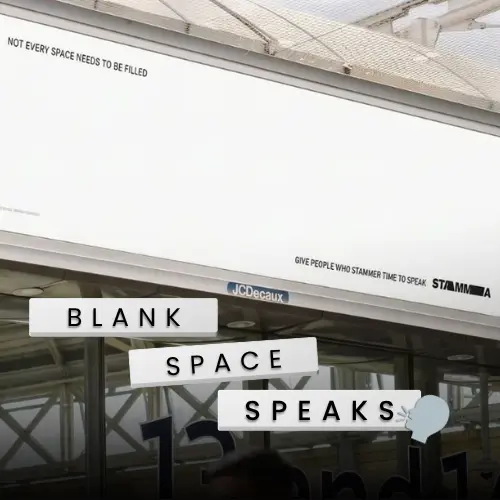
STAMMA and Iris have launched a minimalist OOH campaign across Manchester and Liverpool that intentionally leaves billboard space empty to encourage people to give those who stammer time to speak.
Creative Strategy: Turning Empty Space Into The Message
Most outdoor advertising competes for attention by filling every available inch with visuals, headlines, and branding.
STAMMA’s latest campaign takes the opposite approach.
Created by Iris and supported by pro bono media from JCDecaux, the campaign intentionally leaves large sections of its billboards empty.
The unused space is not a design choice—it is the idea itself.
By leaving room on the billboard, the campaign visually represents the pauses people who stammer experience when speaking.
A Behavioural Insight Hidden In Everyday Conversations
The campaign is based on a striking insight: 14% of people who stammer reported being hung up on during their most recent call to an organisation.
Many people instinctively rush to fill silence because pauses can feel uncomfortable.
However, for someone who stammers, those pauses are often a natural part of communication.
The campaign seeks to shift that behaviour by encouraging audiences to become more comfortable with waiting.
Rather than treating pauses as interruptions, it asks people to recognize them as part of someone’s voice.
OOH Strategy: Using The Medium To Demonstrate The Message
Few campaigns align message and medium as closely as this one.
Outdoor advertising is typically designed to maximize visual impact through density and immediacy.
STAMMA instead uses absence to create attention.
The empty areas become impossible to ignore precisely because audiences expect them to contain something.
The work features just two simple lines:
“Not every space needs to be filled.”
“Give people who stammer time to speak.”
The creative transforms a communication challenge into a public demonstration of empathy.
Why Simplicity Makes The Message Stronger
In busy urban environments, simplicity often creates greater stopping power than complexity.
The campaign’s minimalist approach allows the message to stand apart from surrounding advertising clutter.
Viewers are invited to experience the pause rather than simply read about it.
This subtle interaction creates a deeper emotional connection than a more conventional awareness campaign might achieve.
Building Long-Term Social Change
The campaign supports STAMMA’s wider mission to create a world where people who stammer are heard, included, and able to speak without shame or stigma.
Rather than focusing solely on awareness, the work aims to encourage a specific behavioural change.
Its objective is simple: allow people time to finish their thoughts.
That makes the campaign not just educational, but actionable.
Extending The Message Beyond Outdoor Media
The initial OOH rollout across Manchester and Liverpool will be followed by national cinema and audio activity in July.
Additional support from Pearl & Dean and Acast will help extend the campaign’s reach across multiple environments.
By adapting the same insight across different channels, STAMMA reinforces the importance of patience and listening wherever conversations happen.
Final Reflection: When Silence Becomes A Creative Asset
STAMMA’s campaign demonstrates how powerful advertising can be when it resists the urge to say more.
By leaving space on a billboard, the work creates space in people’s thinking.
The campaign succeeds because it transforms a simple design decision into a meaningful behavioural lesson.
In a media landscape built around grabbing attention, STAMMA reminds us that sometimes the most important thing we can do is wait and listen.
Summary
Supported by pro bono media from JCDecaux, STAMMA’s latest campaign transforms empty billboard space into a powerful behavioural change message. By mirroring the pauses experienced by people who stammer, the work challenges audiences to embrace silence rather than rushing to fill it, helping create a more inclusive environment for communication.
Sources
FAQs
What is the campaign trying to achieve?
The campaign encourages people to give those who stammer time to speak without interruption.
Why is the billboard mostly empty?
The empty space symbolizes the pauses people who stammer experience while speaking.
Where is the campaign running?
The initial rollout appears across Manchester and Liverpool with support from JCDecaux.
Who created the campaign?
The campaign was developed by Iris for STAMMA with pro bono media support from JCDecaux.
FAQs about this campaign
What is the campaign trying to achieve?
The campaign encourages people to give those who stammer time to speak without interruption.
Why is the billboard mostly empty?
The empty space symbolizes the pauses people who stammer experience while speaking.
Where is the campaign running?
The initial rollout appears across Manchester and Liverpool with support from JCDecaux.
Who created the campaign?
The campaign was developed by Iris for STAMMA with pro bono media support from JCDecaux.
Bring your idea to breakfast-time OOH
Explore formats that meet audiences in morning routines and commuter corridors.

Comments
Be the first to comment.