Quick Answer
McDonald’s UK launched Camera Rolls, a multi-channel campaign built from real fan phone galleries showing that nights out often end at McDonald’s.
Cultural Context: The Ritual After the Night Out
Late-night fast food has long been part of British nightlife culture. But rather than dramatizing it through staged scenarios, Camera Rolls taps into documented behavior.
The insight emerged when Leo UK reviewed real camera rolls shared by fans. A recurring pattern appeared: regardless of the event—bowling nights, house parties, weddings or awards shows—the final images often featured McDonald’s. Fries in the back of a taxi. A takeaway bag on a curb. A blurry group selfie under golden arches.
The camera roll is a modern diary. It is chronological, unfiltered and emotionally honest. By using screenshots exactly as they appear on fans’ phones, the campaign reframes brand presence not as advertising insertion but as social evidence.
This aligns with a broader shift in brand storytelling: moving from scripted narrative to behavioral documentation.

The Strategic Insight: Proof Lives in the Scroll
The strategic leap behind Camera Rolls is subtle but powerful. Instead of claiming cultural relevance, McDonald’s proves it.
The scroll mechanic is critical. A camera roll visually builds anticipation. Each image marks progression through a night. When the final frame consistently lands at McDonald’s, the brand becomes the punctuation mark of the evening.
This is not product-led messaging. It is pattern recognition.
By highlighting an observable truth—“no matter where the night starts, the best nights always end at McDonald’s”—the brand transforms habit into identity. It elevates a routine stop into a shared cultural endpoint.
Importantly, this reinforces McDonald’s Overnights platform, which aims to drive late-night footfall. Rather than relying on price promotions, the strategy builds mental availability at the exact moment of decision.

Media Strategy: From Cultural Moment to Ongoing Behavior
The campaign launched during one of the most visible moments in British entertainment: the 2026 Brit Awards. The morning after, creator GK Barry shared her own camera roll from the night, ending at McDonald’s. The post quickly surpassed 100,000 likes, demonstrating the social resonance of the idea.
Influencer management was handled by Red Consultancy, ensuring the activation felt native rather than transactional.
From there, the campaign expands across Instagram and TikTok using platform-specific executions:
-
“Night out” folder reveals
-
Layered camera roll edits
-
Scroll builds that replicate the natural phone experience

Instagram’s “Add Yours” mechanic invites users to share their own end-of-night proof, converting a one-off activation into participatory behavior.
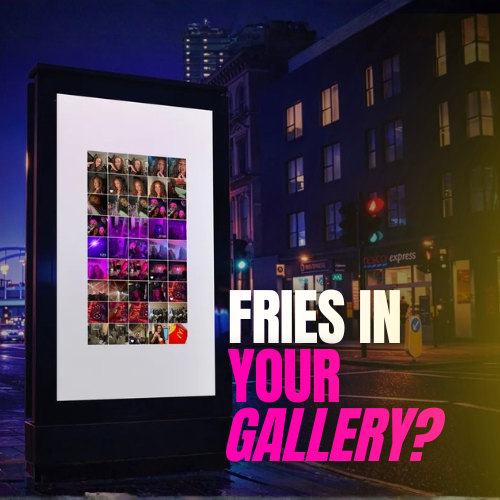
OOH plays a supporting yet strategic role. By translating the vertical scroll format into static and digital outdoor, the campaign bridges private phone behavior with public space. A billboard featuring a camera roll screenshot operates as social validation at urban scale. It invites recognition rather than explanation.
This integration across channels reflects a key trend: campaigns designed not as bursts but as expandable systems that return during concerts, festivals and major sporting events.
Creative Execution: Rawness as Authority
Visually, the campaign resists overdesign. The camera rolls are shown as they are—complete with timestamps, imperfect lighting and unfiltered composition.
This rawness is intentional. It communicates authenticity and positions McDonald’s as an organic part of social life rather than a polished add-on.
Each execution tells a micro-story. A bowling night builds from neon lanes to group selfies, then lands on fries. A wedding night progresses from ceremony shots to dancefloor chaos before closing on a late-night takeaway.
The repetition is the message.
By maintaining the exact visual language of a smartphone interface, the creative feels culturally fluent. It does not mimic social media; it inhabits it.

Strategic Reflection: Turning Habit Into Platform
Camera Rolls demonstrates how brands can convert behavioral data into enduring creative platforms.
Rather than inventing a new association, McDonald’s identifies an existing one and amplifies it. The campaign does not attempt to change behavior. It celebrates it.
From a marketing perspective, this reduces friction. Consumers already see McDonald’s as part of their night-out ritual. The campaign simply codifies that perception.
The decision to design the platform for recurrence across cultural moments—concerts, festivals, major events—signals long-term thinking. The structure is modular. Any night out can generate new creative.
As the campaign expands internationally, its portability becomes clear. The insight is culturally specific yet universally relatable: nights end somewhere.
By transforming private documentation into public storytelling, McDonald’s positions itself not just as a place to eat, but as the final chapter of a shared social experience.
Summary
McDonald's UK partnered with Leo UK to launch “Camera Rolls,” a campaign built on real fan photo galleries that document nights out ending at McDonald’s. Debuting around the Brit Awards, the multi-channel platform extends the brand’s Overnights strategy.
Sources
FAQs
What is the Camera Rolls campaign about?
It is a multi-channel campaign built from real fan camera rolls showing that nights out often end at McDonald’s.
Where did the campaign launch?
It launched in the UK around the 2026 Brit Awards, beginning with influencer activation and expanding across social and OOH.
What makes it innovative?
It uses genuine smartphone camera roll screenshots as creative assets, turning documented behavior into brand proof.
FAQs about this campaign
What is the Camera Rolls campaign about?
It is a multi-channel campaign built from real fan camera rolls showing that nights out often end at McDonald’s.
Where did the campaign launch?
It launched in the UK around the 2026 Brit Awards, beginning with influencer activation and expanding across social and OOH.
What makes it innovative?
It uses genuine smartphone camera roll screenshots as creative assets, turning documented behavior into brand proof.
Bring your idea to breakfast-time OOH
Explore formats that meet audiences in morning routines and commuter corridors.
Comments
Be the first to comment.