Quick Answer
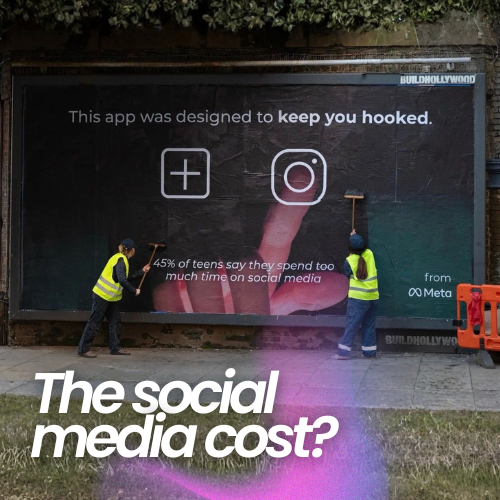
Mad Youth Organise launched a London billboard campaign that mimics tech advertising language to expose the mental health impact of social media platforms.
Reversing the Language of Advertising
The campaign’s core strength lies in its use of familiarity as a weapon.
By mimicking the clean, minimalist style of tech billboards, the work initially feels like a standard platform campaign. But the copy quickly subverts expectations:
-
“The youth mental health crisis – sponsored by Meta.”
-
“Misery starts on TikTok.”
-
“This app was designed to keep you hooked.”
This inversion transforms advertising language into critique, forcing viewers to reconsider messages they are used to accepting without question.

A Cultural Tension Made Visible
The campaign taps into a growing body of concern around social media’s impact on young people.
Issues like anxiety, loneliness, and body image distortion are increasingly linked to high engagement, algorithm-driven platforms.
Rather than presenting new data, the campaign surfaces a widely felt tension:
People already suspect these platforms may be harmful.
The campaign simply makes that suspicion explicit.

OOH as a Medium for Accountability
Out-of-home plays a critical role here.
Unlike digital platforms, where messaging can be controlled, skipped, or personalized, OOH is:
-
Public
-
Unavoidable
-
Shared
By placing these messages in high-traffic areas across London, the campaign turns individual concerns into a collective conversation.
It also uses the same physical spaces often dominated by tech advertising, creating a direct visual and contextual contrast.

From Engagement to Consequence
A key strategic layer is the reframing of engagement itself.
Tech platforms typically position engagement as success:
-
More time spent
-
More interaction
-
More content consumed
This campaign reframes those same metrics as potential harm, suggesting that what benefits platforms may not benefit users.
It challenges the idea that optimization is neutral, instead presenting it as a driver of negative outcomes.

Activism That Borrows From Branding
Created by Mad Youth Organise, the campaign reflects a broader shift where activism adopts the tools of advertising.
Rather than rejecting commercial aesthetics, it repurposes them to deliver critical messages.
This approach increases effectiveness because:
-
The format is instantly recognizable
-
The disruption happens within expectation
-
The message feels more credible in context

Redefining What Outdoor Media Can Do
This campaign highlights a growing role for OOH beyond commercial messaging.
It demonstrates that outdoor media can function as:
-
A platform for public accountability
-
A space for cultural critique
-
A trigger for collective reflection
In doing so, it expands the perceived role of advertising spaces — from persuasion to provocation.
Summary
Mad Youth Organise deployed a series of OOH billboards across London that subvert the visual language of tech advertising to critique platforms like Meta and TikTok. By reframing familiar slogans into accusatory statements, the campaign highlights the growing concern around youth mental health.
Sources
FAQs
What is the campaign about?
It critiques the impact of social media on youth mental health using billboard advertising.
What makes it innovative?
It flips the visual language of tech advertising to deliver a critical message.
What is the strategic insight?
That engagement-driven platforms may contribute to mental health issues among young users.
What media channels were used?
Primarily out-of-home billboards in high-traffic urban areas.
FAQs about this campaign
What is the campaign about?
It critiques the impact of social media on youth mental health using billboard advertising.
What makes it innovative?
It flips the visual language of tech advertising to deliver a critical message.
What is the strategic insight?
That engagement-driven platforms may contribute to mental health issues among young users.
What media channels were used?
Primarily out-of-home billboards in high-traffic urban areas.
Bring your idea to breakfast-time OOH
Explore formats that meet audiences in morning routines and commuter corridors.


Comments
Be the first to comment.