Quick Answer
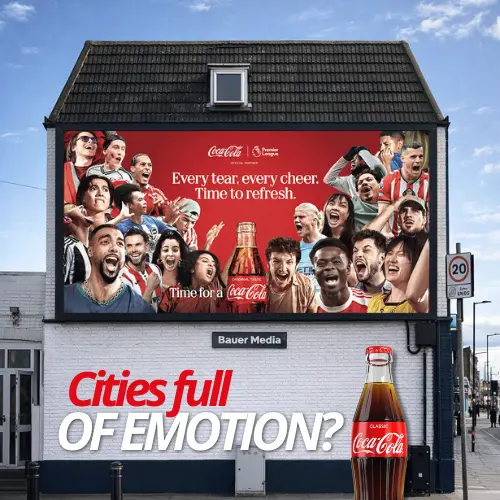
Coca-Cola’s “Time for a Coke” campaign uses nationwide OOH and stadium takeovers across the UK to position the brand within the emotional highs and lows of Premier League football.
Cultural Context: Football Is One of the UK’s Largest Emotional Rituals
Few cultural experiences in the UK create the same level of collective emotional intensity as Premier League football.
Every weekend, millions of fans move through cycles of anticipation, anxiety, celebration, and disappointment. Importantly, these emotions are not confined to stadiums—they spill into pubs, living rooms, train stations, and city streets.
For brands, football offers more than audience scale. It offers emotional participation.
Coca-Cola’s strategy recognizes that the most powerful football marketing does not simply sponsor the game—it becomes part of the ritual around it.
Insight: Football Emotions Extend Beyond the Match Itself
The campaign is built on a strong human truth: football fandom is experienced physically and collectively.
Fans carry emotion with them throughout the day:
- Walking to stadiums
- Waiting in stations
- Gathering in pubs
- Reacting in public spaces
By placing OOH in these environments, Coca-Cola captures football not as a 90-minute event, but as an all-day emotional journey.
The simple line “Time for a Coke” works because it adapts naturally to every emotional state—celebration, tension, relief, or defeat.
Media Strategy: Turning the Entire City Into Matchday Media
The campaign spans large-format OOH, DOOH, stadium takeovers, and landmark placements such as Piccadilly Lights.
This creates a layered ecosystem where the brand appears at key emotional touchpoints before, during, and after matches.
The strategy includes:
- Stadium adjacency for direct fan engagement
- High-street placements for mass visibility
- Dynamic DOOH for emotional responsiveness
- Integration with TV idents and social content
Rather than isolated media buys, the campaign behaves like a connected emotional network.
Creative Execution: Football Through Human Reaction
Visually, the campaign focuses not only on football itself, but on reaction.
The creative pairs cinematic Coca-Cola imagery with:
- Fan celebrations
- Nervous anticipation
- Player intensity
- Shared emotional moments
This is strategically important because emotion—not gameplay—is the brand territory Coca-Cola wants to own.
By showing both highs and lows, the campaign feels more authentic to real fandom.

Stadium Strategy: Embedding the Brand Into Club Identity
The takeover extends across clubs including:
- Arsenal
- Liverpool
- Tottenham Hotspur
- Chelsea
- Aston Villa
- Manchester United
This localized execution strengthens relevance by embedding Coca-Cola directly into club-specific matchday environments.
The brand becomes part of the fan journey before fans even enter the stadium.
Strategic Impact: Simplicity as a Long-Term Platform
“Time for a Coke” is notable for its restraint.
Rather than overcomplicating the messaging, Coca-Cola uses a flexible line capable of adapting across emotional contexts and media formats.
This simplicity gives the platform longevity and scalability through the Premier League partnership running until 2028.
The line works because it does not interrupt the football experience—it fits naturally within it.
Execution Insight: Emotion Works Better Than Performance Messaging
Many football campaigns focus on winning, greatness, or competition. Coca-Cola focuses on feeling.
That distinction matters because emotional universality broadens the audience beyond hardcore supporters.
Everyone understands anticipation, excitement, and disappointment—even casual fans.
By centering emotion instead of results, the campaign becomes more inclusive and culturally durable.
Final Reflection: When OOH Becomes Part of Matchday Atmosphere
Coca-Cola’s Premier League takeover demonstrates how outdoor advertising can evolve beyond visibility into atmosphere creation.
By surrounding fans throughout their matchday journey, the campaign embeds the brand into the emotional rhythm of football itself.
The work succeeds not because it talks about football louder than everyone else, but because it understands what football feels like.
And in sports marketing, emotion remains the most valuable media space of all.
Summary
Coca-Cola launched “Time for a Coke,” a nationwide OOH and DOOH campaign celebrating its partnership with the Premier League. Developed by WPP Open X and led by Ogilvy UK, the campaign transforms stadiums, city centres, and iconic UK media sites into emotional extensions of matchday culture.
Sources
FAQs
What is the campaign about?
It celebrates Coca-Cola’s partnership with the Premier League through a nationwide OOH and DOOH rollout.
Where is the campaign running?
The campaign appears across UK city centres, stadiums, train stations, and landmark sites like Piccadilly Lights.
What makes it innovative?
It turns entire urban environments into emotional extensions of matchday culture.
What was the strategic insight?
Football emotions are experienced throughout the day and across public spaces, not just inside stadiums.
FAQs about this campaign
What is the campaign about?
It celebrates Coca-Cola’s partnership with the Premier League through a nationwide OOH and DOOH rollout.
Where is the campaign running?
The campaign appears across UK city centres, stadiums, train stations, and landmark sites like Piccadilly Lights.
What makes it innovative?
It turns entire urban environments into emotional extensions of matchday culture.
What was the strategic insight?
Football emotions are experienced throughout the day and across public spaces, not just inside stadiums.
Bring your idea to breakfast-time OOH
Explore formats that meet audiences in morning routines and commuter corridors.

Comments
Be the first to comment.