Quick Answer
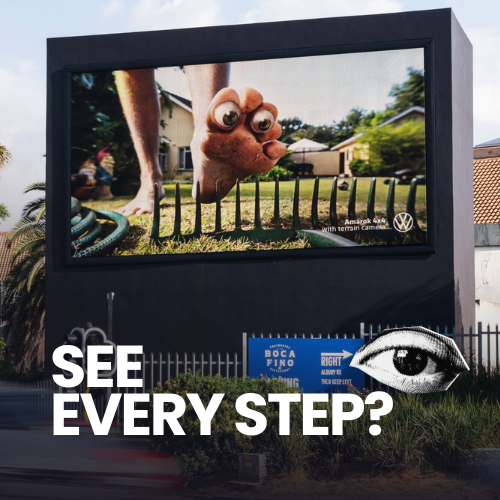
The Amarok 4×4 launched with an OOH campaign using human eyes placed on toes to dramatize its underbody Terrain Camera, proving the feature without showing the vehicle.
Cultural Context: Automotive OOH Has Become Predictably Invisible
In many markets, automotive brands dominate outdoor advertising. Large-format billboards are filled with glossy vehicle packshots, scenic roads, dramatic skies, and interchangeable claims about freedom or performance.
The problem is not lack of spend—it is sameness.
When every brand uses similar visual codes, even expensive media can fade into the background. In South Africa, where OOH is a major battleground for automotive competition, standing out requires more than visibility. It requires creative contrast.
This creates opportunity for brands willing to abandon category conventions.

Insight: People Understand Pain Faster Than Technology
The Amarok’s new Terrain Camera system offers practical value: visibility beneath and around the vehicle in challenging terrain.
But technical features often struggle in mass media because they require explanation. Consumers may not immediately understand camera angles, sensor coverage, or use cases.
The campaign solves this by translating product truth into a universal human experience: stepping on something painful because you couldn’t see it.
Everyone understands the danger of:
- A LEGO brick on the floor
- A garden rake left in grass
- A nail on a dock
This converts abstract technology into immediate emotional comprehension.
Media Strategy: Using OOH for Pattern Interruption
The campaign is built for outdoor environments where attention is scarce and message processing time is short.
Instead of another car visual, audiences encounter bare feet with eyes on the toes mid-step above dreaded hazards. The image is strange enough to stop attention and simple enough to decode instantly.
That makes OOH the ideal medium because it rewards:
- Fast visual surprise
- Clear single-minded ideas
- Distinctiveness at distance
- Memorability through humor
With smaller budgets than competitors, the brand effectively uses creativity as a media multiplier.
Creative Execution: Eyes Underneath
The line “It’s like having eyes underneath” becomes the entire campaign system.
Rather than illustrate the Terrain Camera literally, the executions dramatize it metaphorically. Human eyes appear on the underside of toes, allowing feet to “see” what is below before stepping down.
This is strong creative thinking because it achieves multiple outcomes simultaneously:
- Makes the feature instantly understandable
- Creates humor without weakening utility
- Avoids category clichés
- Builds curiosity through surreal imagery
Notably, the vehicle itself does not appear. That absence is strategic. It forces the audience to engage with the benefit first, not the product shot.
The campaign was photographed on location in South Africa by David Prior, reinforcing authenticity and local production relevance.
Strategic Impact: Selling the Benefit, Not the Spec Sheet
Many automotive campaigns lead with horsepower, torque, trim levels, or feature lists. Amarok leads with consequence avoidance.
That matters because people buy outcomes more readily than specifications.
The Terrain Camera is reframed as:
- Confidence in rough terrain
- Awareness of hidden obstacles
- Protection from costly or painful mistakes
This broadens appeal beyond off-road enthusiasts to any buyer who values reassurance and control.

Competitive Advantage: Distinctive Memory Structure
When dozens of automotive ads compete visually, recall often depends on what is most different.
A truck photo can be forgotten. Eyes on toes above LEGO bricks are harder to erase.
The campaign likely strengthens memory through:
- Novel imagery
- Emotional reaction (pain anticipation)
- Humor
- Clear linkage to the feature
That combination gives the Amarok a stronger chance of being remembered than more expensive but generic competitors.
Execution Insight: Humor Works When It Clarifies
Humor in automotive marketing can sometimes distract from product truth. Here, it does the opposite.
The joke is the explanation.
That is rare and valuable. It means entertainment and persuasion are doing the same job rather than competing for attention.
Final Reflection: When the Car Doesn’t Need to Be in the Ad
The Amarok launch demonstrates a powerful principle in modern advertising: showing the product is not always the best way to sell it.
By dramatizing a real human blind spot, the campaign makes advanced camera technology intuitive, memorable, and culturally shareable.
In a category crowded with polished sameness, Amarok wins by being weird, clear, and useful all at once.
Sometimes the smartest way to launch a car is to leave the car out entirely.

Summary
Volkswagen introduced the new Volkswagen Amarok in South Africa through a bold outdoor campaign that visualizes its 360-degree Terrain Camera system in an unexpected human way. By replacing typical car advertising clichés with humor and instantly relatable pain points, the brand transforms technical product innovation into memorable cultural communication.
Sources
FAQs
What is the campaign about?
It is an OOH campaign launching the new Amarok by highlighting its Terrain Camera feature through surreal imagery.
Where did it launch?
The campaign was produced and released in South Africa across outdoor and social media channels.
What makes it innovative?
It explains a technical vehicle feature without showing the car, using eyes placed on toes above painful hazards.
What was the strategic insight?
People understand unseen danger and painful blind spots faster than they understand technical specifications.
FAQs about this campaign
What is the campaign about?
It is an OOH campaign launching the new Amarok by highlighting its Terrain Camera feature through surreal imagery.
Where did it launch?
The campaign was produced and released in South Africa across outdoor and social media channels.
What makes it innovative?
It explains a technical vehicle feature without showing the car, using eyes placed on toes above painful hazards.
What was the strategic insight?
People understand unseen danger and painful blind spots faster than they understand technical specifications.
Bring your idea to breakfast-time OOH
Explore formats that meet audiences in morning routines and commuter corridors.


Comments
Be the first to comment.