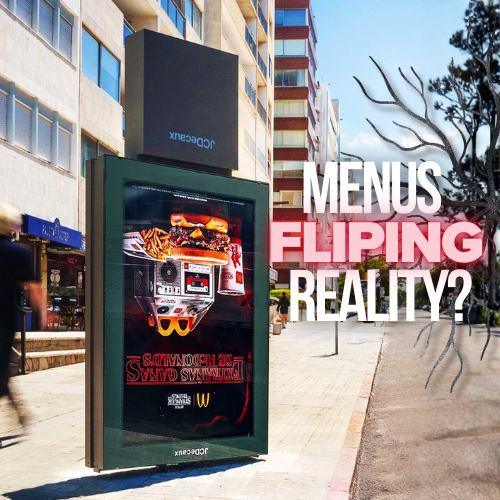
In Montevideo, even street furniture crossed into the Upside Down. To launch McDonald’s Uruguay special Stranger Things menu, this out-of-home campaign brought the show’s parallel universe into the real world.
How McDonald’s brought the Upside Down to the street
On a JCDecaux digital panel, the visuals were displayed completely upside down— as if the screen itself had been pulled into the show’s other dimension. A minimal execution with maximum recognition.
Why this idea works instantly for fans
Stranger Things has a strong visual language, and the Upside Down is one of its most iconic cues. Flipping the orientation of a familiar format turns a standard panel into a giant wink to fans, without needing extra copy or explanation.

Street furniture as pop-culture canvas
By intervening a single piece of urban furniture, the campaign shows how OOH can become part of entertainment storytelling. The city itself becomes an extension of the show’s universe.
Why simple ideas travel far
The strength of the execution lies in its restraint. One clear twist, perfectly aligned with the IP, transforms a digital screen into a shareable moment— proving that sometimes the most effective OOH ideas are also the simplest.

FAQs about this campaign
What was McDonald’s Stranger Things OOH activation in Montevideo?
A digital JCDecaux panel displayed visuals completely upside down to reflect the Upside Down from Stranger Things.
What was the campaign promoting?
McDonald’s Uruguay’s special Stranger Things-themed menu.
Why does the upside-down execution work?
It’s instantly recognizable to fans and visually disrupts everyday street furniture, capturing attention immediately.
What role does digital OOH play here?
Digital panels allow brands to manipulate orientation and visuals in real time, turning simple ideas into powerful experiences.
Bring your idea to breakfast-time OOH
Explore formats that meet audiences in morning routines and commuter corridors.
Comments
Be the first to comment.